12 March, 2008

A tragedy of Olympian proportions

A saga started exactly 80 years ago. It went like this:

Gold, Gold, Gold, Gold, Gold, Gold, Silver, Gold, Bronze, Bronze, _, Gold. Thus it ended with a silver, nay, Gold lining 28 years ago.

In the Golden era during 1928 - 1956, India played 24 Olympic matches, winning all 24, scoring 178 goals and conceding only 7.

After 28 consecutive victories in the Olympic Games, India lost 0-1 to Pakistan in the final at the Rome Olympics in 1960, but regained its 'Golden' status in the next Olympics. But...

then started the real trouble.


Thereafter, we had to be smug with Bronze, Bronze, and then no medal at all. With the sole exception of 1980 Moscow Olympics, Indian Hockey was virtually thrown out of Olympic games. Though initially there was a hue and cry, India quickly got accustomed to playing qualifying games (initially thought to be "insulting" to a team which has a glorious past) just to get into the Olympics as IHF started playing with the game more unabashedly.

This time, Had India won the crucial match against China in Asian Games 2006, it could have reached the finals and there would not be any need for playing the qualifying matches. But it didn't happen.

Had it won the final match against England yesterday,... But it didn't happen either.

As usual, blame game starts which is played more fervently than the game itself, one or two heads will fall and Indian Hockey will rest in peace. Amen!

02 December, 2007

Birds of same feathers meet on Dec. 9th

(Updated with venue details)

First a brief introduction about TMAD (To Make A Difference): They are a group of young people who are committed indeed To Make A Difference in the lives of hapless people.

TMAD started as a group of volunteers in Hyderabad, but now has active members in Bangalore, Chennai, the USA, Nellore and other places also. The person behind this movement is Prasanti who firmly believes "When you want something, the whole universe conspires in helping you to achieve it". A look at their projects - completed and current (Note: The website is still under construction and a few pages are yet to be added): http://tomakeadifference.net/Projects.html

If you are impressed and interested, you too can join them To Make A Difference.

To join TMAD, one must:

* have interest in doing something to the society
* be ready to spend at least one weekend for the group work in a month

After joining,

* Subscribe to one or more subgroups of your interest (Medical, Education, etc.)
* Participate in monthly meetings
* Contribute money* and/or time and/or effort
* Share opinions, come up with suggestions by participating in mail discussions.

TMAD members are meeting the coming Sunday ie, 9th Dec. This is a meeting with members from like-minded groups. If you want to attend the meeting, please contact

prasanthi [dot] uppalapati [at] gmail [dot] com

before Dec. 4th.

Meeting details:


Venue and Timings:


Venue: Floor No 2, Taxila Training Hall, Mariner Block, Ascendas IT PArk, Hitech City (Should bring ID card). Those who are working can bring their company ID card. Others can bring Voters card, Ration card, Driving License or anything that gives the identity.

Timings: 10 am to 5 pm (We request all participants to be there at the venue by 9:30 am).

Strict Guideline: Those who are ready to be there all day long only should come. We will not give any reservation to anyone.

It would be a day long meeting. We request you all to mark the entire day. Incidentally this is Anti-Corruption Day.

Note: Meals and snacks will be arranged.

Participants:


Individuals and groups who are interested to spare at least two days in a month for social work activity and who, as of now, does not have one particular area to concentrate on. Most importantly who believe in co-operation and bringing our work to a next level.

Preparation:


Every participant should come up with their profile in the following details:

Name, Qualification, Employment/Designation, Email and Phone Number
Inspiration to do social work: 1 or 2 incidents or persons
Most unforgettable experiences: 1 or 2
Area of interest in social work:
Your views on likeminded groups’ forum and meeting.
If member of any groups, give the group’s name, aim, URL and any other useful information.

For groups, one person from the group should explain about the group, aim, objectives, past and current activities and future projects.

For the members of the groups who visited different orphanages, old age homes etc., please come up with all the details that you have about these institutions and their requirements and the kind of support that you expect for your efforts.

Agenda:


Introduction, Welcome/Ice-breaking Speech: 10 minutes

First Session: 1 ½ hour

To know about the interest and views of each participant with respect to social work and also of the participant groups.


Second Session: 1 ½ hour

To identify areas of common interest and to discuss on each topic in the six hat method. (All the six hats are not considered; the purpose is to let everyone on the same page when they think on an aspect.)

Third Session: 1 ½ hour

To know about different organizations and orphanages that the participants visited. (Brief description of 5 to 10 minutes about each organization)

Meanwhile we will have 10 minute breaks. We can have jokes and songs. Participants can exhibit their talent. We will be more than happy if the selections are related to the topics of discussion.

There would be a 10 min briefing from a group about human values and how we can develop the humanity in us and how we can be of good individuals.

Outcome: 1 hour

At the end of the day we should come up with a plan of action on the way we co-operate and co-ordinate with others. May be like any other formal meeting we will come up with a 10 point agreement sort of thing. In simple words, conclusion of the meeting agreed by all the participants.

Lunch Break: 1 hour

Snack Break: 15 min

Photos: 15 min

Guidelines:


Meeting should start on time.
Every participant should value the time and speak on what we are supposed to talk.
No one should object and contradict others’ views. We should be good listeners.

Possibilities:


We request participants to bring their laptops if they own one. This is to enable any of your friends who are not located in Hyderabad to participate virtually.

Expected Count:

We are expecting a minimum of 50 members and maximum of 100 members.


Request:


Please understand the urge behind organizing this meeting. Completely co-operate and confirm your participation. Own this meeting.

We can assure that every participant will be happy to meet so many likeminded people, inspiring experiences and leave with a renewed commitment and hope.

Measure of Success:

Every participant should feel happy
Pledge to continue this kind of meetings
Come up with a date for next meeting

Last but not the least:

Please confirm your participation at least by Dec. 3rd. We once again request members to co-ordinate with your groups and come up with a consolidated list from each group.

Mail to: Prasanthi, prasanthi[dot]uppalapati[at]gmail[dot]com

Disclaimer: This meeting is strictly for people who spare/willing to spare two days a month for social work.
------------------------
* Those who contribute money to TMAD can rest assured that each rupee they send is spent for the cause. Not a single paisa is spent on commuting or administrative charges. Volunteers bear the charges.

16 April, 2007

Please stop!


1. An appeal to Mr. Rahul Gandhi:
Sir! will you please before you do more damage to your family's reputation, your party's popularity and the nation's honour? Far better if you "read out" well-drafted speaches rather than talking nonsense.


2. An appeal to the media: will you please stop reporting anything related to the Aishwarya-Abhishek marriage? To me, it is disgusting to say the least. As you report everyday -

it is news if they invite xyz to their marriage.
it is news if they don't.

it is news if they order the wedding suites.
it is news if they got the design earlier.

it is news if they meet.
it is news if they don't.

it is news if they smile at each other.
it is news if they don't.

it is news if they go to temple.
it is news if they don't.

Why are you so obsessed with their marriage?
Can't you do anything better??

14 March, 2007

Triumph nonpareil


Yesterday's cartoon:

Today's editorial:

Viswanathan Anand's ascent to the pinnacle in the world of chess is a widely anticipated crowning moment in an extraordinary sporting journey. The true significance of his achievement — he will be the No.1 player when the new rankings are released in April 2007 — will challenge the Indian sporting imagination. For chess is just one part sport. The famous sport of kings is a sort of mental warfare and supremacy here has a meaning all its own. A prodigy who won the world junior championship in 1987 at the age of 17, Anand has beaten a gritty uphill path to greatness, combining natural cognitive genius with patience and perseverance. With an admirable sense of purpose and a steely resolve, the boy nicknamed Lightning Kid — for the awesome speed with which he made his moves — overcame several hurdles early in his career. Today, as he surveys the scene from the game's Everest, Anand can be proud of the revolution he has brought about in India. Nineteen years ago, the suave, wonderfully uncomplicated champion was India's first and only grandmaster. Today, he is the best among 15. Such is the transformative power of pioneering accomplishments.

Anand is Indian sport's most celebrated outsider. Life would have been so much easier had he possessed the kind of gifts on display in popular field sports such as cricket, football, and tennis. Having nothing to declare except a rare genius for moving tiny pieces on a 64-square board, he lacked the support systems that might have eased the path of a Sachin Tendulkar or a Leander Paes. At age 22, Anand took a major step forward, winning the Reggio Emilia title in what was, at that time, the strongest field ever. He finished ahead of Garry Kasparov and Anatoly Karpov in the 10-man event. Three years later, he opened up an early lead against Kasparov in the world championship final at the World Trade Center in New York before the champion inflicted a nerve-shattering defeat on the young Indian. Lesser men might have let their careers drift at that point but Anand regrouped to stay near the top. With his career moving into overdrive, he beat Alexei Shirov in Tehran to win the world title in 2000. Three years later he added the World Rapid Championship to his magnificent collection. Last year, the 37-year-old became only the fourth player in history to cross the 2800-mark in ELO ratings — a ranking system devised by a Hungarian-born American physics professor Arpad Elo (1903-1992). The No.1 ranking following victory in the Linares Super Grandmaster tournament might have been a logical step up the ladder for the Indian maestro. As an individual achievement, it has no parallel in the history of Indian sport.

18 February, 2007

Who the hell is this lady?

Why isn't she put behind the bars??


These two pictures show the gross disrespect and insult to the Indian National flag by this so-called "spiritual leader" and self-proclaimed "GODDESS" Mataji Nirmala Devi. This disrespect to our country's flag shows that she has definitely no respect or love for the country. What is more, her husband C.P.Srivatsava who was an IAS officer and chief of the SCI is seated next to her in the pictures. (He represented India in the UNO for 16 years!) Such a shame!!!

02 January, 2007

Star versus The Real Star

Our media and our heroes


This morning, I received this truly saddening email about a brave army officer who laid his life down in an encounter with Hizbul Mujahideen’s most wanted terrorist. Saddening….and a disgusting commentary on the media in general...

On Tuesday Nov 28th ‘06, a news swept across all the news channels 'Sanjay Datt relieved by the court', 'Sirf Munna Not a bhai', '13 saal ka vanvaas khatam', 'although found guilty for possession of armoury, Sanjay can breath a sigh of relief as all the TADA charges against him are withdrawn'.

And then many experts like Salman khan saying 'He is a good person. We knew he will come out clean' Mr. Big B 'Datt family and our family have relations for years. He's a good kid. He is like elder brother to Abhishek'. His sister Priya Datt 'we can sleep well tonight. It's a great relief'

In other news, Parliament was mad at Indian team for performing bad; Greg Chapel said something ...; Bomb scare in gorakhpoor express; and Shah Rukh Khan replaces Big B in KBC and Sonia asked PM to consider reducing petroleum prices. But most of the emphasis was given to Sanjay Datt's "phoenix like" comeback from the ashes of terrorist charges.

Surfing through the channels, one news on BBC startled me. It read: 'Hizbul Mujahidin's Most wanted terrorist 'Sohel Faisal' killed in anantnag, India. Indian Major leading the operation lost his life in the process. Four others are injured.'

It was past midnight, I started visiting the foolish Indian channels, the ones who are 'Sabse TEZ', but Sanjubaba was still ruling. They were telling how Sanjubaba pleaded with the court saying 'I am the sole bread earner for my family', 'I have a daughter who is studying in US and who will look after her'. And then they showed how sanjubaba was not wearing his lucky blue shirt while he was hearing the verdict. Also how he went to every temple and prayed for last some months. A suspect in Mumbai bomb blasts, convicted under armory act...was being made into a hero.

Sure Sanjubaba has a daughter; sure sanjubaba did not do any terrorist thing as in bombing some place or hijacking an airplane etc. Possessing an AK47 is considered too elementary in terrorist community and also one who possesses an AK47 has a right to possess a pistol so that again is not such a big crime; Sure sanjubaba went to all the temples; Sure he did a lot of gandhigiri but then... people, please read on...


Major Manish H Pitambare got the information from his sources about the terrorists' whereabouts. Wasting no time he attacked the camp killed the Hizbul mujahidin's supremo and in the process lost his life... To the bullets fired from an AK47..


He has a wife and a daughter (just like sanjubaba), age ...18 months.


Major Manish never said 'I have a daughter' before he took the decision to attack the terrorist hide out in the darkest of nights.

He never thought about having a family and he being the bread earner.


No news channel covered this since they were too busy hyping a former drug addict, an actor in real and reel life, a suspect who's linked to bomb blasts which killed hundreds. Their aim was to show how he defied the TADA charges and they were so successful that his conviction in possession of armory had no meaning. They also concluded that his parents in heaven must be happy and proud of him..

Parents of Major Pitambare are still on this earth and they have to live the rest of their lives without their beloved son. His daughter won't ever see her papa again.


Finally Sir Major Pitambare, to my generation there is no greater hero than the one who laid his life in the name of this great nation. Hence Sir, I salute you. We are really proud of you. We salute your braveness which will make us live in peace in the future.

You are the real Star, Vande mataram!

Also read:
munnabhai-vs-manish-pitambare

Rediff

and

what Archana says about our media.

01 December, 2006

The president and the God-man

The poet-President & the “creator of the universe”


India’s President Dr. APJ Abdul Kalam has been the chief guest during the glamorous birthday show of controversial godman Sai Baba on 23rd November 2006. It is shameful and outrageous that the Indian President pays respect to a saffron charlatan, who exploits the gullible by claiming that he can produce "holy ash" from thin air, cure all illnesses, has created the universe and other nonsense more. It aggravates the case against President Kalam that he did not content himself with performing a kind of public relations routine, but went out of his way praising and glorifying the charlatan.

“I have immense love for Sai Baba”, Dr. Kalam said in his speech at Sai Baba’s headquarters in Puttaparthi. “I penned a poem in my mother tongue to greet Sai Baba on his birthday.” And he was not ashamed to read his poem (in a Telugu translation of the Tamil original) publicly to the cheering crowd of Sai Baba devotees. The rather embarrassing piece glorified Sai Baba as a glittering lighthouse and symbol of goodness. Because of Sai Baba’s presence, the President of India rejoiced, the earth was the most blessed planet in the solar system.

This is not only extremely silly and in bad taste. It is moreover irresponsible and undignified to a degree that is not compatible with the august office of the Indian President. President Kalam has misrepresented India and betrayed the trust of her people. India deserves a (more) dignified and responsible President.

Sanal Edamaruku
President, Indian Rationalist Association and
Rationalist International


India’s President Dr. APJ Abdul Kalam & Satya Sai Baba


The scientist-President & the exposed miracle man

It is deplorable that there are still many poor people in India, who are deprived of basic education and who don’t have any opportunity to develop scientific literacy. They are easy prey for frauds, fanning their fears and raising their hopes with “miracles” and promises of magical solutions for all problems. Miracle mongers and faith healers are inflicting a dangerous disease upon the weakest section of Indian society and have to be stopped by all means. It has to be one of the primary tasks of human development in India, to help the victims of superstition and blind belief to break the shackles of their archaic mindset and join the twenty first century.

Besides being the Indian President, Dr. Abdul Kalam is seen as one among the most prominent scientists of India and has raised great hopes for a better future, guided and protected by science. His concept “Vision 2020” promises to lead India smoothly into the orbit of the developed world. If a man of this stature and position uses his influence to come to the rescue a scandal-tainted godman, he commits a serious and unpardonable betrayal.


http://innaiahn. tripod.com
N.Innaiah

29 November, 2006

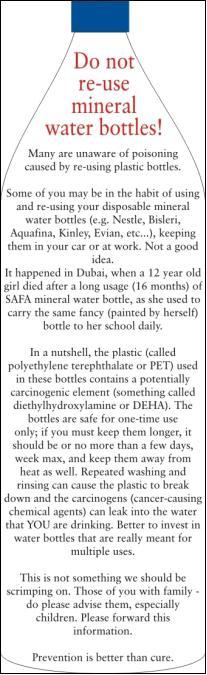
Do not reuse mineral water bottles


It happened in Dubai, when a 12 year old girl died after a long usage(16 months) of SAFA mineral water bottle as she used to carry the same fancy (painted by herself) bottle to her school daily.

In a nutshell, the plastic (called polyethylene terephthalate or PET) used in these bottles contains a potentially carcinogenic element (something called diethyllydroxylamine or DEHA). The bottles are safe for one-time use only; if you must keep them longer, it should be or no more than a few days, weeks max, and keep them away from heat as well. Repeated washing and rinsing can cause the plastic to break down and the carcinogens (cancer-causing chemical agents) can leak into the water that YOU are drinking. Better to invest in water bottles that are really meant for multiple uses.

17 November, 2006

Child sexual abuse

Some alarming facts about Child Sexual Abuse (CSA):


(From TULIR website)

Statistical data from available research and reported incidents (from children and adult survivors) clearly indicates that child sexual abuse is a widespread problem affecting an extremely large number of children in the country.

Child sexual abuse occurs in all social and economic classes of society.

The majority of abusers are known to the child and are often in positions of trust and power vis-à-vis the child. Example: Family, relatives, neighbours, teachers etc.
Most children are sexually abused inside their own homes, as abusers have the trust of children and their families and access to their homes.

All children(girls and boys) are vulnerable to sexual abuse. Research has proven that differently able children are in fact more likely to be abused because of their increased vulnerabilities.

Children do not lie or weave stories about being sexually abused. The pressure to remain silent to uphold distorted concepts of honor and respect is immense. Also, children in our society are kept ignorant of sex and the possibility of abuse. Given these two facts the child is not lying when he/she relates an incident of sexual abuse.

Children can never initiate sexual abuse. Terming a child's behavior "seductive" is an adult justification, projection and misinterpretation.

Abusers are seldom mentally ill; on the contrary they are "regular" people who lead "routine" lives

Though most of abusers are men, a small number of women also abuse children sexually.

In most reported cases the abuser is not physically violent but uses emotional manipulation to coerce the victim.

Usually nobody is aware that the child is being sexually abused.

Child sexual abuse usually has harmful effects and can lead to behavioral, emotional, physical and interpersonal problems.

If child sexual abuse is not reported then the same abuser may harm other children or may target the same child again. There is very often a pattern to abuser's behaviour. They usually repeat their behaviour and with many children as well.

Children of any age can be abused. Reported incidents show that even infants have been sexually abused.

For more details, like:


personal safety rules,

Healing and intervention,

Parents' practical response to CSA,

CSA at Schools: Role, Responsibility and Response,

Preventing and healing CSA,

What exactly is CSA,

Who the abusers are,

How they "groom" children,

Indicators and Effects of CSA,

Responsibilities of parents, schools, community,

FAQ's, Newsletter, etc,

visit TULIR website.

16 November, 2006

Main causes of liver damage

The main causes of liver damage are:

1. Sleeping too late and waking up too late are main cause.
2. Not urinating in the morning.
3. Too much eating.
4. Skipping breakfast.
5. Consuming too much medication.
6. Consuming too much preservatives, additives, food coloring , and artificial sweetener.
7. Consuming unhealthy cooking oil. As much as possible reduce cooking oil use when frying, which includes even the best cooking oils like olive oil. Do not consume fried foods when you are tired, except if the body is very fit.
8. Consuming raw (overly done) foods also add to the burden of liver.
Veggies should be eaten raw or cooked 3-5 parts. Fried veggies should be finished in one sitting, do not store.

We should prevent this without necessarily spending more. We just have to adopt a good daily lifestyle and eating habits. Maintaining good eating habits and time condition are very important for our bodies to absorb and get rid of unnecessary chemicals according to "schedule."
Because :

9 pm - 11 pm : is the time for eliminating unnecessary/ toxic chemicals (detoxification) from the antibody system (lymph nodes). This time duration should be spent by relaxing or listening to music. If during this time a housewife is still in an unrelaxed state such as washing the dishes or monitoring children doing their homework, this will have a negative impact on health.

11pm - 1 am : is the detoxification process in the liver, and ideally should be done in a deep sleep state.

Early morning 1 - 3 am : detoxification process in the gall, also ideally done in a deep sleep state.

Early morning 3 - 5 am : detoxification in the lungs. Therefore there will sometimes be a severe cough for cough sufferers during this time. Since the detoxification process had reached the respiratory tract, there is no need to take cough medicine so as not to interfere with toxin removal process.

Morning 5 - 7am : detoxification in the colon, you should empty your bowel.

Morning 7 - 9 am : absorption of nutrients in the small intestine, you should be having breakfast at this time. Breakfast should be earlier, before 6:30 am , for those who are sick. Breakfast before 7:30 am is very beneficial to those wanting to stay fit. Those who always skip breakfast, they should change their habits, and it is still better to eat breakfast late until 9 - 10 am rather than no meal at all.

Sleeping so late and waking up too late will disrupt the process of removing unnecessary chemicals. Aside from that, midnight to 4:00 am is the time when the bone marrow produces blood. Therefore, have a good sleep and don't sleep late.


DO TAKE CARE ABOUT YOUR HEALTH .

15 November, 2006

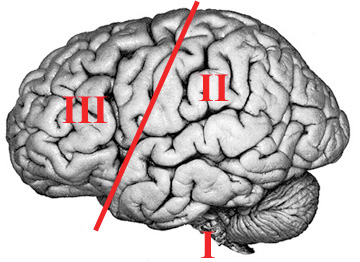
BRAIN DAMAGING HABITS


1. No Breakfast
People who do not take breakfast are going to have a lower blood sugar level.
This leads to an insufficient supply of nutrients to the brain causing brain degeneration.


2. Overeating
It causes hardening of the brain arteries, leading to a decrease in mental power.


3. Smoking
It causes multiple brain shrinkage and may lead to Alzheimer disease.


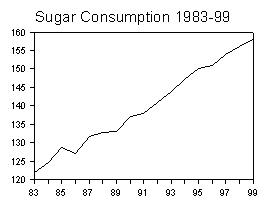
4. High Sugar consumption
Too much sugar will interrupt the absorption of proteins and nutrients causing malnutrition and may interfere with brain development.


5. Air Pollution
The brain is the largest oxygen consumer in our body. Inhaling polluted air decreases the supply of oxygen to the brain, bringing about a decrease in brain efficiency.


6. Sleep Deprivation
Sleep allows our brain to rest. Long term deprivation from sleep will accelerate the death of brain cells.


7. Head covered while sleeping
Sleeping with the head covered, increases the concentration of carbon dioxide and decrease concentration of oxygen that may lead to brain damaging effects.


8. Working your brain during illness
Working hard or studying with sickness may lead to a decrease in effectiveness of the brain as well as damage the brain.


9. Lacking in stimulating thoughts
Thinking is the best way to train our brain, lacking in brain stimulation thoughts may cause brain shrinkage.


10. Talking Rarely
Intellectual conversations will promote the efficiency of the brain.

(A forwarded mail with minor modifications)

Slowing down diabetes


(Today's editorial)

Slowing down diabetes

The two most potent weapons against diabetes continue to be regular physical activity and healthy eating habits. But with new evidence, medical research has strengthened the view that the burden of Type 2 diabetes mellitus is rising because of expanding urbanisation accompanied by changing food preferences, a sedentary entertainment-oriented lifestyle, rising automobile dependence, and a pedestrian-unfriendly physical environment. Many experts think these factors raise the risk among Indians who may be genetically predisposed to diabetes; the Indian Council of Medical Research estimates the prevalence of diabetes among adults to be 11.8 per cent in urban areas, compared to 3.8 per cent in the rural. The negative impact of non-traditional choices of food and a couch-bound lifestyle seems to be evident in the Philippines and Cambodia, besides India. A lower percentage of rural residents develop diabetes in these countries compared to their urban counterparts, according to an article on epidemic obesity and Type 2 diabetes published recently in The Lancet. These findings point to a strong link between poorly planned urbanisation, now happening in many states, and the onset of chronic conditions such as diabetes.

While those who have already developed diabetes must depend on advances in medical care and a disciplined lifestyle to maintain a good quality of life, millions of others can avoid or delay onset of the disease. The answer lies in reshaping urban development models. The World Health Organisation has emphasised the good outcomes for public health under its Healthy Cities Programme, which envisages municipal bodies actively integrating urban planning and health concerns. A framework for action is available in the forward-looking policies of the United Progressive Alliance Government on urban renewal, transport, and public health. These have to be translated into ground-level results with incentives available for good practice. Of equal importance is the Union Health Ministry's initiative to ensure that the packaged food industry adopts labelling that provides accurate nutritional and calorific values of products. Combined with an awareness-building programme on obesity-related diseases (in which the medical community can play a major role), this measure will enable everyone, especially the youth, to make healthy choices. The experience of many developed economies shows that encouraging physical activity and other health-seeking behaviour contributes in part to a lower burden of chronic diseases. The battle against diabetes in India has a better chance of success if the combat strategy includes opening of more parks, playgrounds, gymnasia, stadiums, and pedestrian and cycling facilities.

23 October, 2006

What Is Sexual Harassment?

From: India Together

(In the landmark Vishaka case in 1997, The Supreme Court recognised sexual harassment as human rights violation and gender based systemic discrimination that affects women's Right to Life and Livelihood.)

According to The Supreme Court definition, sexual harassment is any unwelcome sexually determined behaviour, such as:-

* Physical contact
* A demand or request for sexual favours
* Sexually coloured remarks
* Showing pornography
* Any other physical, verbal or non-verbal conduct of a sexual nature.

Sexual Harassment takes place if a person:

# subjects another person to an unwelcome act of physical intimacy, like grabbing, brushing, touching, pinching etc.
# makes an unwelcome demand or request (whether directly or by implication) for sexual favours from another person, and further makes it a condition for employment/payment of wages/increment/promotion etc.
# makes an unwelcome remark with sexual connotations, like sexually explicit compliments/cracking loud jokes with sexual connotations/ making sexist remarks etc.
# shows a person any sexually explicit visual material, in the form of pictures/cartoons/pin-ups/calendars/screen savers on computers/any offensive written material/pornographic e-mails, etc.
# engages in any other unwelcome conduct of a sexual nature, which could be verbal, or even non-verbal, like staring to make the other person uncomfortable, making offensive gestures, kissing sounds, etc.

It is sexual harassment if a supervisor requests sexual favours from a junior in return for promotion or other benefits or threatens to sack for non-cooperation. It is also sexual harassment for a boss to make intrusive inquiries into the private lives of employees, or persistently ask them out. It is sexual harassment for a group of workers to joke and snigger amongst themselves about sexual conduct in an attempt to humiliate or embarrass another person.

Quid pro quo and hostile work environment are the two broad types of sexual harassment.

Sexual harassment at workplace is generally classified into two distinct types. 'Quid pro quo', means seeking sexual favours or advances in exchange for work benefits and it occurs when consent to sexually explicit behaviour or speech is made a condition for employment or refusal to comply with a 'request' is met with retaliatory action such as dismissal, demotion, difficult work conditions. 'Hostile working environment' is more pervasive form of sexual harassment involving work conditions or behaviour that make the work environment 'hostile' for the woman to be in. Certain sexist remarks, display of pornography or sexist/obscene graffiti, physical contact/brushing against female employees are some examples of hostile work environment, which are not made conditions for employment.

Unwelcome:

UNWELCOME is the key in defining sexual harassment. It is the impact and effect the behaviour has on the recipient that will define the behaviour as sexual harassment.

What is a workplace?
A workplace is any place where working relationships exist, where employer - employee relations exist.

For more details like combating Attitudes,
The employers', colleagues' and trade unions' responsibilities
etc., visit India Together

Sexual harassment at workplace


"Sexual harassment at workplace continues"

Special Correspondent

Most women not aware of Supreme Court guidelines, says study in health sector

Appropriate implementation mechanism lacking
No direct action against perpetrators

NEW DELHI: Notwithstanding the Vishaka judgment, sexual harassment continues to dog many women in the health sector, a study entitled "Sexual Harassment in the Workplace" and sponsored by the Population Council has said.

What is required is an appropriate implementation mechanism that recognises the obstacles posed by power imbalances and gender norms in empowering women to make a formal complaint on the one hand and in receiving appropriate redress on the other, it said.

The study explored women's perceptions and experiences of sexual harassment in the health sector in Kolkata. It confirmed the reluctance of women to invoke the complaints mechanism and the ineffectiveness of the existing system in punishing the perpetrator.

Power imbalances

While leading forms of harassment were verbal or psychological, a significant number reported unwanted touch, and sexual gestures and exhibitionism. Experiences reflected, by and large, power imbalances that make younger women and those in subordinate positions particularly vulnerable. Incidents of harassment were most often perpetrated by people in authority, such as senior or consultant doctors and even patients and their families, perceived to have the power to influence the women's job security in the institution.

Few women, however, took formal action and complained to their supervisors or to the hospital management. Action taken in these cases was, by and large, indirect and rarely involved confronting the perpetrator or dismissing him.

Most women were not aware of the Supreme Court guidelines and complaints mechanism/formal institutions of redress. Many others feared attitudes that would blame them for provoking an incident or feared the loss of their reputation as a result of complaining.

They also realised their relatively powerless positions and feared job-related discrimination, including dismissal and withholding of promotions.

Much remains

The 135 in-depth interviews with women employees were conducted over a period of 11 months. Respondents were employed in four hospitals — two government and two private. In addition, 40 interviews were conducted with heads of institutions of the four hospitals, unions and association heads.

In 1997, the Supreme Court recognised sexual harassment at the workplace as a violation of human rights.

The landmark judgment outlines a set of guidelines (Guidelines on Sexual Harassment at the Workplace) for the prevention and redress of complaints by women of sexual harassment at workplace.

"While the Supreme Court guidelines have opened up the discourse on sexual harassment at workplace, it is clear that much remains to be done to address gender stereotyping and harassment at the working place and to ensure that women have recourse to effective resolution of complaints," the study said.

31 August, 2006

HIV-AIDS: II

(Continued from "HIV-AIDS: MYTHS and FACTS-I")

Some more information (sent by Dr.Ismail):

TRANSMISSION OF THE VIRUS:


HIV transmission can occur when blood, semen (cum), pre-seminal fluid (pre-cum), vaginal fluid, or breast milk from an infected person enters the body of an uninfected person.

HIV can enter the body through a vein (e.g., injection drug use), the lining of the anus or rectum, the lining of the vagina and/or cervix, the opening to the penis, the mouth, other mucous membranes ( e.g., eyes or inside of the nose), or cuts and sores. Intact, healthy skin is an excellent barrier against HIV and other viruses and bacteria.

These are the most common ways that HIV is transmitted from one person to another:

* by having sex (anal, vaginal, or oral) with an HIV-infected person;
* by sharing needles or injection equipment with an injection drug user who is infected with HIV; or
* from HIV-infected women to their babies before or during birth, or through breast-feeding after birth.

HIV and AIDS:


Prior to 1996, scientists estimated that about half the people with HIV would develop AIDS within 10 years after becoming infected. This time varied greatly from person to person and depended on many factors, including a person's health status and their health-related behaviors.

Since 1996, the introduction of powerful anti-retroviral therapies has dramatically changed the progression time between HIV infection and the development of AIDS. There are also other medical treatments that can prevent or cure some of the illnesses associated with AIDS, though the treatments do not cure AIDS itself. Because of these advances in drug therapies and other medical treatments, estimates of how many people will develop AIDS and how soon are being recalculated, revised, or are currently under study.

Also see the blog: iMedicine

30 August, 2006

HIV-AIDS: MYTHS and FACTS-I

Recently I have received a forwarded mail which stressed the need for creating awareness among the public about HIV and AIDS. The mail was from "Mayank, Brand Manager (Product Manager) handling anti HIV/AIDS portfolio (called as Antiretroviral Drugs) in Ranbaxy...". Here I go with more details and clarifications from Dr. Ismail who is doing research on HIV and TB in New jersy.
I am grateful to Trivikram, Bangalore and Vidya Sagar, hyderabad who forwarded this mail to me and also to Dr. Ismail who responded to my mail despite his busy schedule.

MYTHS:


As per the mail, "There was a story on junk some days back where it is said that a boy got infected by HIV virus by eating pani-puri.

Dr. Ismail says: Not true...virus will not survive and no transmission is reported through ingestion.

And there have also been rumours where people are affected by the HIV virus when they got pricked by an HIV infected needle in theaters..."

Dr. Ismail says: Maybe, if it is a fresh prick and the chance is 0.3% only even then.

NOW THE FACTS:


HIV (virus) requires *ONLY* *Blood or Semen* as medium to transmit from one body to another.

Dr. Ismail says: Even contact of mucous membranes is enough for transmission , saliva does contain virus but transmission is negligible....

HIV *can not* transmit even through *Saliva* (mucous) i.e. even if HIV-infected patient coughs and another person is exposed to his sputum (cough), the virus still can not transmit because concentration of virus particles in sputum is almost NIL & exposure to air anyway kills virus in fraction of seconds.


Dr. Ismail says: last sentence is true but not in seconds though!

In case HIV-infected person got an injury (like the cut in below mentioned story) and he is bleeding, the virus can transmit to another person only if another person has a cut/wound in his body & that too when *blood from both person comes in contact with each other* (this is also very very rare unless bleeding is very high) and not otherwise.

Dr. Ismail says: True but when blood contacts a breach in mucous membrane infection is possible theoritically!

HIV can never survive in any liquid medium other than blood or semen (& please for God sake ... never in Pani Puri wala's pani).

Dr. Ismail endorses: Not in pani-puri but HIV is found in varying concentrations or amounts in blood, semen, vaginal fluid, breast milk, saliva, and tears.

Even if one drinks an HIV infected blood (or semen) of someone (ingest through Gastro Intestinal track), the virus can not survive in the acidic pH of stomach. Highest extent of acidity is 0 (practically not possible) so imagine 1 as pH which is in our stomach.

Dr. Ismail says: True.
(Note: pH levels in our stomach may go as low as 1.0. This is a very acidic level. Solutions at a pH of 1.0 are strong enough to burn through fabrics, injure eyes or irritate skin. When food comes into the stomach, the pH may rise to 3.0 to 4.0)

there have also been rumours where people are affected by the HIV virus when they got pricked by an HIV infected needle in theaters..."

Dr. Ismail says: Maybe, if it is a fresh prick and the chance is 0.3% only even then.

Exposure of less than 1 second in AIR KILLS the HIV virus (story of needle pricks in Cinema theatres goes down the drain) .. Even if blood from a wound (of infected person) dries up (*blood clot*), *the virus dies* and can not infect anyone else.

Dr. Ismail says: True but as I mentioned earlier if that guy can make a prick on himseld and again prick other person and if the needle enters a vein or bloodvessel there is a risk of transmission.

HIV transmission is *ONLY* an *INFECTION* i.e. entrance of virus in one's body. It *DOES NOT MEAN AIDS*.

Dr. Ismail says: True AIDS is a later stage in the spectrum of illness caused by HIV and as a matter of fact people die of other infections like TB and diarrhea caused by lowering of immunity by HIV and not by HIV perse.

An HIV-infected person (after entrance of virus) can progress to condition of AIDS usually after *8 to 10 YEARS* (not in 15 days as in the mentioned story)

Dr. Ismail says: It may take from few months to 10 years depending on the viral load and innate immunity of the individual

It is *not HIV (virus) nor AIDS that kills a human* ..... the virus attacks immune cells (cells that fight against foreign pathogens/antigens) and hence a person's ability to fight against infections & diseases slowly diminishes and the person ultimately dies of a disease which is most likely TB.

Most importantly, HIV is no longer a dreadful disease .... it is "* CHRONIC MANAGEABLE DISEASE*" just like Diabetes or Hypertension.

Dr. Ismail says: It can be managed with practising healthy methods and antiretrovirals but can't be compared to Diabetes or Hypertension.

If there is anything you need to be careful from to prevent HIV, it is *Unsafe Sex*, *Blood transfusion* (check before taking) / Blood donation (use sterilized needles only) and any *blood contact during an accident *or so where amount of bleeding is very high.

(See the next post: HIV-AIDS: II)

23 August, 2006

Vande Mataram

A few "Letters to the Editor" published in today's The Hindu:

The controversy triggered by the Union Human Resource Development Minister's observation that the recitation of Vande Mataram in educational institutions is not mandatory and the statement of the Jama Masjid Shahi Imam, Syed Ahmed Bukhari, that its rendition is against the tenets of Islam is unfortunate. The national song only salutes the motherland. -Ahmad M. Abdi, Mumbai

Vande Mataram is nothing but a greeting to the motherland and an appreciation of its enchanting natural beauty. It is just a patriotic national song. Let us not offer a narrow, religious interpretation to it. -Mumtaz Ali Khan, Bangalore

'Vande Mataram' was one among the many slogans that united India. According to an HRD directive to the States, the national song must be recited in all educational institutions on September 7 to mark its centenary. Mr. Singh has now indicated that the recitation is not mandatory. Is it necessary to pander to the sentiments of a few in such matters? -D. Venkateswar Rao, Paloncha, A.P.

Is it in order for the Centre to direct the educational institutions to recite the song to honour the patriots and then give in to objections from some quarters? -M.S. Rajasekaran, Chennai

That the recitation of the national song has been made voluntary so as not to hurt the sentiments of a few who feel asking them to sing it would amount to their suppression is condemnable. At a time when the youth are unaware of the origin and importance of our national anthem and song, Mr. Singh's move will go a long way in ensuring that they remain thus. -Mahesh Kolary, Palakkad, Kerala

Defending poet Subramania Bharati's patriotic songs that were banned by the British, Congress leader Satyamurthi pointed to the universality of his songs. The U.S. currency carries the words `In God We Trust,' though many atheists have objected to them. Everyone who is proud to be an Indian should respect the national song. Minority or majority sentiment should not be attached to it. -V.E. Venkataramani, Chennai

18 August, 2006

What led to floods?

From Gargi Parsai's report in The Hindu

Expert says the authorities waited for the dams to fill up before releasing the water

The dams had 47 per cent water before the monsoon
This is "negligence" of operations


NEW DELHI : It seems that mismanagement and negligent operations of the large reservoirs on the rivers cause the floods in Gujarat, Maharashtra, Madhya Pradesh, Karnataka and Andhra Pradesh.

Himanshu Thakkar of the South Asia Network on Dams, Rivers and People, claims that the big dams that were expected to regulate water flows were actually responsible for the floods in these States that also happen to have the largest number of big reservoirs. Dams in these States had an average of 47 per cent storage before the monsoon set it, which in itself was a potential for causing floods.

Demanding a probe into what caused floods in these States and whether they were avoidable, Mr. Thakkar said action should be taken against those responsible for "mismanagement."

"The nation has paid huge costs in creating these reservoir capacities, and negligence in the dam operations is leading to disastrous consequences which are entirely avoidable," he said.

Storage

Officials from the Central Water Commission told that normally dams were supposed to be emptied out before monsoon by releasing water for irrigation and other purposes. "Reservoir storages are built up at the end of the monsoon, to prevent floods downstream."

But as per the Central Water Commission statistics, in the Tapi basin, various dams had upto 41 per cent storage before monsoon.

In the Narmada basin, the Tawa dam was already filled up to 22.58 per cent before the monsoon.

Likewise, in the Krishna basin, the Koyna dam was filled up to 25.19 per cent, the Khadakvasla up to 12.5 per cent, the Narayanpur up to 44.1 per cent, the Srisailam up to 17 per cent and the Nagarjunsagar was filled up to 47.08 per cent.

In the Godavari basin, the Jayakwasi had a storage of 28.33 per cent and in the Sabarmati basin, the Dharoi dam was filled up to 42.59 per cent.

Mr. Thakkar said releases from the dams — under instruction from the State Irrigation departments — after the onset of the monsoon were normally kept under wraps. More often than not, the secrecy hid gross neglect and mismanagement, as had happened this year.

He alleged that the large-scale loss of lives and businesses in Surat could have been avoided by early, regulated releases when it was known that the Ukai dam across the Tapi was filling up fast. The dam was 51 per cent full on July 20, 77.54 per cent full on August 3 and 100 per cent on August 7. Even when it was getting high inflows of up to nine to ten lakh cusecs, the authorities waited for the dam to fill up before releasing water. This meant the sudden release of up to 10 lakh cusecs for several days, leading to unprecedented flooding. This, when the Tapi downstream from dam had a drainage capacity of only about 3.5 lakh cusecs. The releases also coincided with high tide, leading to prolonged flooding.

Mr. Thakkar claimed that in the Sardar Sarovar Project also, the main canal was opened by just 0.5 metres on August 2, releasing just about 580 cusecs,when inflows were over 98,000 cusecs. Downstream releases were just around 21,000 cusecs. This led to a build-up of water, of up to 128 metres, leading to "illegal and avoidable" submergence of land, houses and habitats of thousands of rural and tribal families. The situation was similar in the Krishna, Godavari and Sabarmati basins.

03 August, 2006

New Report

`Pesticide levels in soft drinks too high'

THE HINDU Special Correspondent
****************************************************************
New study indicates pesticides 24 times higher than Bureau of Indian Standards norms

# "The levels in some samples exceeded the BIS standards by 140 times for the deadly pesticide Lindane, a confirmed carcinogen"
# "Heptachlor, banned in India, was found in 71 per cent of the samples, at levels four times higher than BIS standards"
****************************************************************
NEW DELHI: The Centre for Science and Environment (CSE) on Wednesday came out with a new report on the levels of pesticides in soft drinks available in the market.

The report indicated the presence of an average of three to five different pesticides in all the samples, 24 times higher than the Bureau of Indian Standards (BIS) norms, which have been finalised but not yet notified.

The latest CSE study is based on tests conducted on 57 samples of 11 soft drink brands from 25 different manufacturing plants of Coca-Cola and Pepsico, spread over 12 States.

The levels in some samples — for instance, Coca-Cola bought in Kolkata — exceeded the BIS standards by 140 times for the deadly pesticide Lindane, a confirmed carcinogen.

Similarly, a Coca-Cola sample manufactured in Thane contained 200 times more of the neurotoxin, Chlorpyrifos, than the BIS standard, said Sunita Narain of CSE releasing the report here.

Three years after the centre released its first findings on pesticide residue in soft drinks, the new study shows that nothing much has changed and soft drinks remain unsafe and unhealthy. Even the directions given by the Joint Parliamentary Committee have been disregarded: standards for safety have been finalised but blocked because of opposition by the companies, Ms. Narain alleged.

In 2003, the average level of pesticide residue in samples from Delhi was 34 times above the same BIS standard, but this time the CSE has found pesticide residue as high as 52 times in bottles brought in Kolkata and 42 times in bottles bought in Nainital and Gorakhpur. Similarly, bottles bought in Mumbai, manufactured in Thane and Nagpur, allegedly had residue 34 times above the BIS standard.

Heptachlor, banned in India, was allegedly found in 71 per cent of the samples, at levels four times higher than BIS standards.

The average amount of pesticide residue found in all the samples was 11.85 parts per billion (ppb) or 24 times higher than the BIS standards for total pesticides in soft drinks (0.5 ppb). Pepsi Cola contained 30 times higher residue on an average, while Coca-Cola contained 27 times higher than average.

Endorsed by JPC

The current study was conducted by the same Pollution Monitoring Laboratory of CSE that had tested the samples in 2003, and the methodology was endorsed by the JPC despite doubts raised by the cola companies over the veracity of the tests. This time further improvements had been made, and the laboratory now had ISO 9001:2000 quality management system accreditation and it was equipped with state-of-the-art GS-MS equipment, Ms. Narain said.

In February 2004, confirming the unsafe levels of pesticides in soft drinks, the JPC had directed the Government to set standards for these residues in the products. Since then, BIS has, in its sectional committee, met over 20 times to deliberate on the standards, and in October 2005 the standards were finalised.

Ms. Narain alleged that the final standards were being opposed by the Union Health and Family Welfare Ministry on the ground that more research needed to be done. In this respect, she quoted a letter written by the Union Health Secretary to his counterpart in the Ministry of Consumer Affairs. The letter was written on March 29, 2006 — the day the standards were to be formally finalised. The standards were finalised, but not notified, Ms. Narain said.

18 July, 2006

WE PROTEST!!!

Thousands of blogs are blocked in India.
Last week, CERT-IN* (Indian Computer Emergency Response Team ) sent a list of 22 websties and blogs to be blocked to all ISPs following apprehensions by the country's intelligence agencies that these were likely being used by terrorists to communicate with one another. The move may be related to the bomb blasts in trains in Mumbai earlier this month which killed about 190 people and injured around 700. There are about 150 ISPs in India. Although the communication from the DOT to ISPs lists specific pages and Web sites, several ISPs have blocked some key blogs altogether because they were not equipped to filter specific pages.

Access to all blogs and websites hosted on the following servers is currently blocked:
xxx.blogspot.com/
xxx.typepad.com/
xxx.blogs.com/
www.geocities.com/xxx
Spectranet, Mahanagar Telephone Nigam Limited (MTNL), Reliance Powersurfer, Airtel Broadband and Sify have blocked Blogger.

Whoever has done that for any reason, its effect is that thousands of blogs have been blocked. Clearly this is violation of Right to Freedom of Expression guaranteed by the Constitution of India as a Fundamental Right under Article 19(1)(a) which says

19. Protection of certain rights regarding freedom of speech, etc.—(1) All citizens shall have the right—
(a) to freedom of speech and expression;

(b) to assemble peaceably and without arms;
(c) to form associations or unions;
(d) to move freely throughout the territory of India;
(e) to reside and settle in any part of the territory of India; and
* * * * *
(g) to practise any profession, or to carry on any occupation, trade or business.

This right is subject only to reasonable restrictions imposed by the Govt. in the interests of the sovereignty and integrity of India, the security of the State, friendly relations with foreign States, public order, decency or morality, or in relation to contempt of court, defamation or incitement to an offence.

The ISPs are clearly violating this provision of the constitution by arbitrarily blocking all the blogs.

Tricks to access blocked sites:


1. http://www.proxify.com
2. http://censorship.wikia.com/wiki/Bypassing_The_Ban


--
*CERT-IN: Under the Information Technology Act, 2000, the Indian government set up the Indian Computer Emergency Response Team (CERT-IN) in 2003 with the authority to block Web sites. Any government department seeking a block on any web site has to approach CERT-IN, which then instructs the DoT to block the site after confirming the authenticity of the complaint. On receiving instructions from CERT-IN, DOT - which has regulatory control over the ISPs - has to ensure that the Web sites are blocked, and inform CERT-IN accordingly.