In India, three wings of democracy are:
The Legislature (The highest authority is the Lok Sabha Speaker. Within the House, even the Prime Minister has to obey the Speaker's orders and the cabinet is answerable to the House run by the Speaker.)
The Judiciary (The highest authority is the Chief Justice of India.)
and The Executive (The highest authority is the President of India.)
Persons holding these high offices are expected to set and follow high moral standards. Mr. Somnath Chatterjee could have avoided the embarrassment by resigning from the post of Sriniketan Santiniketan Development Authority immediately after allegations were made against him for holding the office however strongly he feels that it is NOT an "office of Profit". It does not augur well for Indian democracy if such high offices are dragged into avoidable controversies.
25 May, 2006


24 May, 2006
Subhash Kashyap
Subhash Kashyap is by far the most venerated constitutional expert. His books on Indian Constitution and the Parliament are indispensable for any student of Indian polity even as part of General Studies. He was Constitutional Adviser to the Government of India and was a Member of the National Commission on the Review of the Working of the Constitution and Chairman of its Drafting Committee (2000-2002). Earlier, he headed the CIDP at IPU (Inter-Parliamentary Union) in Geneva. But he himself is now involved in a controversy over the privileges of Parliament. It is very clear that the Speaker's decision ''cannot be questioned either in the House or outside''. Mr. Kashyap resorted to sort of sacrilege by casting aspersions on the impartiality of the Speaker.
On 4th August, 2005 Trinamool Congress chief Mamata Banerjee was informed that her adjournment motion on 'Inflitration in West Bengal and part of North-Eastern region' was disallowed by the Speaker under Rule 338, which states that the House cannot take up an issue which has already been discussed and negatived in the same session. Her notice was rejected on July 26 and Leader of the Opposition L K Advani's adjournment motion on the same topic was admitted and discussed, it was pointed out. On this, Mamata walked to the well of the House and threw some papers towards the Chair.
On the same day, commenting on this particular incident in a TV channel Kashyap said: ''Well, it has a personal aspect also which should not be forgotten. When Mamata Banerjee was elected to Lok Sabha for the first time, she had defeated a personality like Somnath Chatterjee.'' This kind of remarks are totally unwarranted.
What miffed the panel more was the fact that Kashyap made light of the matter by saying ''papers were torn and thrown like missiles on many occasions in the Lok Sabha. Even shoes and chappals were shown inside the House many a time''. It may be true but throwing shoes at a member is different from throwing them at the speaker. If we overlook even when Lakshman rekha is crossed saying several lines were crossed earlier, nothing beside remains. From this, it is also very clear that we are becoming more and more insentient.
He was also quoted as having said ''there are many instances when discussions on the same subject have been held twice or more during the same session'', but he could not substantiate this point before the Committee. It is appalling that even such 'experts' talk so casually on TV.
Though Lok Sabha has never admonished anyone before, it has 'reprimanded' - considered to be a harsher punishment - two persons previously:
Aug 29, 1960: R K Karanjia was reprimanded for calling Sucheta Kriplani "KripLooney"
Dec 9, 1970: Deputy secretary S.C. Mukherjee was reprimanded for misleading the Committee of Public Undertaking while giving evidence
On 4th August, 2005 Trinamool Congress chief Mamata Banerjee was informed that her adjournment motion on 'Inflitration in West Bengal and part of North-Eastern region' was disallowed by the Speaker under Rule 338, which states that the House cannot take up an issue which has already been discussed and negatived in the same session. Her notice was rejected on July 26 and Leader of the Opposition L K Advani's adjournment motion on the same topic was admitted and discussed, it was pointed out. On this, Mamata walked to the well of the House and threw some papers towards the Chair.
On the same day, commenting on this particular incident in a TV channel Kashyap said: ''Well, it has a personal aspect also which should not be forgotten. When Mamata Banerjee was elected to Lok Sabha for the first time, she had defeated a personality like Somnath Chatterjee.'' This kind of remarks are totally unwarranted.
What miffed the panel more was the fact that Kashyap made light of the matter by saying ''papers were torn and thrown like missiles on many occasions in the Lok Sabha. Even shoes and chappals were shown inside the House many a time''. It may be true but throwing shoes at a member is different from throwing them at the speaker. If we overlook even when Lakshman rekha is crossed saying several lines were crossed earlier, nothing beside remains. From this, it is also very clear that we are becoming more and more insentient.
He was also quoted as having said ''there are many instances when discussions on the same subject have been held twice or more during the same session'', but he could not substantiate this point before the Committee. It is appalling that even such 'experts' talk so casually on TV.
Though Lok Sabha has never admonished anyone before, it has 'reprimanded' - considered to be a harsher punishment - two persons previously:
Aug 29, 1960: R K Karanjia was reprimanded for calling Sucheta Kriplani "KripLooney"
Dec 9, 1970: Deputy secretary S.C. Mukherjee was reprimanded for misleading the Committee of Public Undertaking while giving evidence
22 May, 2006

11 May, 2006
No cross talk plz...
When I visited SreeKalahasti temple for the first time, I was awed by its splendour. It is really an architectural marvel. But when I went there again, what caught my attention was an altogether different matter. It was this:
A devotee was performing some yagna. I don't know what it was. Only one priest was officiating this yagna on his behalf. Flames were lit and the oblations were thrown into the flames one by one. So far so good. Suddenly a cell phone rang. And the ring tone was a romantic song! Whose was it anyway? Definitely it was not mine for two reasons:
1. My cell phone always plays THE BORING(?) TRING TRING.
2. While entering any place of worship or any library, I never forget to switch it off.
Well, Whose was it anyway? To my astonishment, it was the PRIEST's! He didn't show any signs of embarrassment, and lifted the phone and talked as if he was expecting the call. I got furious and also curious and kept watching him. At least 4 or 5 times he talked over the phone and more frequently he kept yacking in the middle of the yajna with whoever comes there. Meanwhile the devotee started showing signs that he was restive but chose to remain silent and be patient! 'What is this?' I asked myself about the priest. Isn't this asking God to 'hold on' in the middle of a dialogue/process that too done on behalf of a third party? How can a priest behave in such an outrageously irresponsible way? Is he really a believer? Does he really understand the importance of the yagna he is performing and what it means to the devotee? and the feelings of the devotee who entrusted him with the task of speaking on his behalf with God???
In the first place, why don't some people switch off the cell phones in the premises of the temple? How disturbing and nauseating it is if the cell phone rings while others are meditating on God? Temple, or for that matter any place of worship, is and should be a place which gives us peace of mind and the best way to get that mental peace is to forget about the outside world for a while and concentrate on God. For this, a peaceful atmosphere is a prerequisite. If THAT is lacking there, if the silence is broken by crazy ringtones, what is the use of going to temples and where else can we go? We only get more disturbed.
I don't really understand those who purposefully let the cell phone ring and respond to the calls in such places and those who MAKE calls from there. They should understand the feelings of their fellow devotees. If they are really expecting any important calls, they had better stay away fom temples till they answer all their important and urgent calls.
In Chilukuru Balaji temple near Hyderabad, everyday the priest keeps reminding the devotees repeatedly to switch off their cell phones.
A devotee was performing some yagna. I don't know what it was. Only one priest was officiating this yagna on his behalf. Flames were lit and the oblations were thrown into the flames one by one. So far so good. Suddenly a cell phone rang. And the ring tone was a romantic song! Whose was it anyway? Definitely it was not mine for two reasons:
1. My cell phone always plays THE BORING(?) TRING TRING.
2. While entering any place of worship or any library, I never forget to switch it off.
Well, Whose was it anyway? To my astonishment, it was the PRIEST's! He didn't show any signs of embarrassment, and lifted the phone and talked as if he was expecting the call. I got furious and also curious and kept watching him. At least 4 or 5 times he talked over the phone and more frequently he kept yacking in the middle of the yajna with whoever comes there. Meanwhile the devotee started showing signs that he was restive but chose to remain silent and be patient! 'What is this?' I asked myself about the priest. Isn't this asking God to 'hold on' in the middle of a dialogue/process that too done on behalf of a third party? How can a priest behave in such an outrageously irresponsible way? Is he really a believer? Does he really understand the importance of the yagna he is performing and what it means to the devotee? and the feelings of the devotee who entrusted him with the task of speaking on his behalf with God???
In the first place, why don't some people switch off the cell phones in the premises of the temple? How disturbing and nauseating it is if the cell phone rings while others are meditating on God? Temple, or for that matter any place of worship, is and should be a place which gives us peace of mind and the best way to get that mental peace is to forget about the outside world for a while and concentrate on God. For this, a peaceful atmosphere is a prerequisite. If THAT is lacking there, if the silence is broken by crazy ringtones, what is the use of going to temples and where else can we go? We only get more disturbed.
I don't really understand those who purposefully let the cell phone ring and respond to the calls in such places and those who MAKE calls from there. They should understand the feelings of their fellow devotees. If they are really expecting any important calls, they had better stay away fom temples till they answer all their important and urgent calls.
In Chilukuru Balaji temple near Hyderabad, everyday the priest keeps reminding the devotees repeatedly to switch off their cell phones.
29 April, 2006
Water bottles

From the above figure, it is clear that
the total cost on a water bottle is Rs. 2.85 - 4.25 (excluding labour, marketing and tax)
But the selling cost is 10.00 to 12.00
Take for instance the case of Coca-Cola's bottling plant in drought-prone Kala Dera near Jaipur. Coca-Cola gets its water free except for a tiny cess (for discharging the wastewater) it pays to the State Pollution Control Board - a little over Rs.5,000 a year during 2000-02 and Rs.24,246 in 2003. It extracts half a million litres of water every day - at a cost of 14 paise per 1,000 litres.
So, a Rs.10 per litre Kinley water has a raw material cost of just 0.02-0.03 paise.
(It takes about two to three litres of groundwater to make one litre of bottled water.)
However, water is not that cheap in the United States, home to Coca-Cola and PepsiCo. The average cost of industrial water in the U.S. was Rs.21 per 1,000 litres in the late 1990s. It was Rs.90/1,000 litres in the United Kingdom and Rs.76/1,000 litres in Canada.
Huge real costs
The reason that companies do not have to bear the cost of the main raw material - water - has made this industry highly profitable. But the real cost of the industry is huge.
The cost of fast-depleting groundwater is incalculable and so is the cost of disposal of plastic bottles and pouches. These are hidden costs that society and the environment pay and will pay in the future. The sale of bottled water is therefore not environmentally sound by any stretch of the imagination.
There are much cleaner ways to access clean and healthy water and for this we will have to rethink our water paradigm.
Groundwater is the cleanest and cheapest source for all, but we have over-extracted and polluted it with natural contaminants, agro-chemicals and industrial waste. We will have to recharge and revive our groundwater bodies and for this the existing archaic law must change.
Our surface water bodies are in a deplorable condition. We dump our sewage and industrial waste in rivers and ponds, try to clean them in massive centralised treatment plants and then supply the water to urban households - to be discharged again as wastewater into the same waterbody. This vicious cycle must be cut and stopped. The cost of dirty water is just too great for society to bear. Bottled water and domestic treatment systems are a cheap as well as fill-and-forget solution for 30 per cent of the population, but in doing so we have not left any solution for the 70 per cent of the poor and the marginalised.
(Excerpts from an article in Frontline dated April 08-24, 2006, Written by Chandra Bhushan, Associate Director, Centre for Science and Environment, New Delhi.)
Reservations
The purpose (providing social justice or equal opportunities for all) with which the reservations were started was lost. With the reservations, people with vested interests have found that caste is a good bargaining tool approved by the govt and hence can be utilised for personal gains. With this, in India, the society "has been broken up into fragments by narrow domestic walls (Tagore's Geetanjali)" and these walls are cemented by the reservation system. New systems have brought with them new evils.
The other side of the coin is that where the real problem ie, caste based discrimination still exists, the reservations have become ineffective. (ex: 1. a school teacher who was a Dalit was not allowed to enter the school which functions in the premises of a temple. 2. In another village, school children, at the behest of their parents, refused to eat the mid day meal cooked by a Dalit woman). People must be educated that caste based discrimination is inhuman. Mere reseravtions have not helped us much in achieving this.
Moreover, reservations always remind us of the caste to which we belong: forward, backward, Scheduled, etc. We observe that everyday, more castes are demanding that they must be promoted in the caste hierarchy by being included in a more beneficial group. At least now, we must understand that a system which nurtures the caste consciousness in us, cannot remedy caste-based discrimination.
Supplying text books free of cost and giving scholarships to economically backward students is much better than reservations. No child must be denied admission into any school based on caste or social status. Admission into colleges and employment opportunities must be based solely on merit. Anything that develops caste consciousness must go. Reservations must go.
Initially, Reservations were thought to be only a temporary provision but now... nobody is thinking in that direction. God! save my country!!
The other side of the coin is that where the real problem ie, caste based discrimination still exists, the reservations have become ineffective. (ex: 1. a school teacher who was a Dalit was not allowed to enter the school which functions in the premises of a temple. 2. In another village, school children, at the behest of their parents, refused to eat the mid day meal cooked by a Dalit woman). People must be educated that caste based discrimination is inhuman. Mere reseravtions have not helped us much in achieving this.
Moreover, reservations always remind us of the caste to which we belong: forward, backward, Scheduled, etc. We observe that everyday, more castes are demanding that they must be promoted in the caste hierarchy by being included in a more beneficial group. At least now, we must understand that a system which nurtures the caste consciousness in us, cannot remedy caste-based discrimination.
Supplying text books free of cost and giving scholarships to economically backward students is much better than reservations. No child must be denied admission into any school based on caste or social status. Admission into colleges and employment opportunities must be based solely on merit. Anything that develops caste consciousness must go. Reservations must go.
Initially, Reservations were thought to be only a temporary provision but now... nobody is thinking in that direction. God! save my country!!
NBA and Rehabilitation

From an exclusive report in today's The Hindu
A Sardar Sarovar Project Status Report submitted by the Union Water Resources Ministry to the Prime Minister's Office on March 22 — after Narmada Bachao Andolan activists went on an indefinite dharna here — nails the claims of the States concerned on rehabilitation of dam-displaced families.
The report reveals that 36,921 families in 226 villages in Gujarat, Madhya Pradesh and Maharashtra will be affected consequent to the raising of the height of the Narmada dam to 121.92 metres. 27,934 families were affected in three states at the height of 110.64 metres. The report clearly shows that 13,233 families remained to be resettled in Madhya Pradesh alone at 110.64 metres.
Even when the Centre was armed with this crucial, authentic information, it sought to put the burden of proving the number of displaced families on the NBA. The NBA protested against raising the height of the dam, saying about 35,000 displaced families between the heights of 110.64 and 121.92 metres remained to be rehabilitated.
The Narmada tribunal award and the Supreme Court held that families facing submergence should be rehabilitated at least six months ahead of raising the dam height, by December 31, 2005.
The NBA has demanded suspension of construction of the dam until the rehabilitation of the displaced families is completed as per the law and not with cash compensation.
Growing intolerance
Ah, I have not updated this blog for a long time now. Almost two months! Meanwhile, several things have happened. I am particularly concerned about the growing intolerance among the people. See what happened when Amir Khan extended support to the Narmada Bachao Andolan (NBA), which has opposed raising of the height of the Sardar Sarovar dam across the river.
NBA offices in Gujarat were ransacked. Youth Congress workers stalled the screening of Aamir Khan movie 'Rang De Basanti'. The workers also burnt Aamir's posters at Aradhana theatre, where the movie is being screened and appealed his fans to come out of the hall, police said. BJP youth wing workers burnt effigy of Aamir Khan in Ahmedabad.
A local Congress leader Narendra Ravat said they will not allow screening of Aamir Khan's film in the city, while the president of Gujarat unit of Youth Congress Mihir Shah has threatened that movie theatres in Gujarat will not be allowed to screen his movies.
National general secretary of BJP youth wing Amit Thakar said they will not allow screening of Aamir's films in entire Gujarat, Mumbai, Jaipur and Bhopal from April 15.
"We will teach him a lesson by not allowing to screen any of his films in future," he threatened.
What's happening? Everyone in the society has a right to say and do what they want, subject only to public order, decency and morality. Then, why this intolerance when a celebrity says or does what he feels? Why can't those 'workers' try to explain what they feel and convince the peolpe and get their support? Why this misplaced anger? Where are we going?
More land will be irriagted if the dam's height is raised. But it is feared that huge dams lead to environmental disasters. Suggested alternatives are: a large number of small dams, check dams, soak pits, and rainwater harvesting, etc.
And the immediate concern of people like Medha Patkar is the welfare of the people who get displaced as a result of raising the height of Sardar Sarovar Dam. These people get uprooted from their villages with top priority, get deported to another palce where, having lost their links with their homeland, with their past, with their means of livelihood, they are left in the lurch as unwelcome guests in the new place without even proper shelter if at least the rehabilitation work is not done properly.
They in fact allege that the Centre and the concerned State governments have been negligent in pursuing the task of rehabilitating the displaced people as a result of raising the height of Sardar Sarovar Dam.
Patkar fears and for genuine reasons that, the displaced people will lose everything they have and gain nothing as the Govt's promised rehabilitation will be too late and too little as she feels that the rehabilitation work is not being done in accordance with directive of the Narmada Water Disputes Tribunal and the Supreme Court’s orders.
NBA offices in Gujarat were ransacked. Youth Congress workers stalled the screening of Aamir Khan movie 'Rang De Basanti'. The workers also burnt Aamir's posters at Aradhana theatre, where the movie is being screened and appealed his fans to come out of the hall, police said. BJP youth wing workers burnt effigy of Aamir Khan in Ahmedabad.
A local Congress leader Narendra Ravat said they will not allow screening of Aamir Khan's film in the city, while the president of Gujarat unit of Youth Congress Mihir Shah has threatened that movie theatres in Gujarat will not be allowed to screen his movies.
National general secretary of BJP youth wing Amit Thakar said they will not allow screening of Aamir's films in entire Gujarat, Mumbai, Jaipur and Bhopal from April 15.
"We will teach him a lesson by not allowing to screen any of his films in future," he threatened.
What's happening? Everyone in the society has a right to say and do what they want, subject only to public order, decency and morality. Then, why this intolerance when a celebrity says or does what he feels? Why can't those 'workers' try to explain what they feel and convince the peolpe and get their support? Why this misplaced anger? Where are we going?
More land will be irriagted if the dam's height is raised. But it is feared that huge dams lead to environmental disasters. Suggested alternatives are: a large number of small dams, check dams, soak pits, and rainwater harvesting, etc.
And the immediate concern of people like Medha Patkar is the welfare of the people who get displaced as a result of raising the height of Sardar Sarovar Dam. These people get uprooted from their villages with top priority, get deported to another palce where, having lost their links with their homeland, with their past, with their means of livelihood, they are left in the lurch as unwelcome guests in the new place without even proper shelter if at least the rehabilitation work is not done properly.
They in fact allege that the Centre and the concerned State governments have been negligent in pursuing the task of rehabilitating the displaced people as a result of raising the height of Sardar Sarovar Dam.
Patkar fears and for genuine reasons that, the displaced people will lose everything they have and gain nothing as the Govt's promised rehabilitation will be too late and too little as she feels that the rehabilitation work is not being done in accordance with directive of the Narmada Water Disputes Tribunal and the Supreme Court’s orders.
08 March, 2006
Holi (Holy?)
Holi - the festival of colours is round the corner. Is it THE most popular festival of India? It seems so. Lately, it has become immensely popular. In India, basically festivals are of two types:
1. Which commemorate a religious event (like killng of Narakasura-Dipavali, etc). These are limited to a particular RELIGION
and
2. Which are related to seasons (onset of monsoon-Eruvaaka and reaping of harvest in Rabi-Sankranti). These are limited to a particular REGION.
Holi seems to be one festival celebrated with much brouhaha across all regions and religions. In celebrating Holi, there is no sense of piousness (piety?) that is so predominant in other festivals. Only jubilation and celebration is present. This is an occasion for many to release their pent-up emotions. And they utilise it to the fullest extent. They can always play mischief and some youthful pranks. They feel that they can go around and drench just anyone in paint or water and daub colours on their body.
Visit Holi Hungama to know more about the festival.
Visit Kalranga to see Holi pictures.
Well, now something that I really want to tell you, seriously...
1. Ensure that the colours that you use are NON-TOXIC. (Making India Green)
2. Please don't block the roads.
3. Be careful not to spurt colors on the front glasses, windows or rear view mirrors of any vehicle.
4. Make sure that you don't play Holi with anyone against their wish, especially strangers....and PLEASE SPARE ME.
HAPPY HOLI!
1. Which commemorate a religious event (like killng of Narakasura-Dipavali, etc). These are limited to a particular RELIGION
and
2. Which are related to seasons (onset of monsoon-Eruvaaka and reaping of harvest in Rabi-Sankranti). These are limited to a particular REGION.
Holi seems to be one festival celebrated with much brouhaha across all regions and religions. In celebrating Holi, there is no sense of piousness (piety?) that is so predominant in other festivals. Only jubilation and celebration is present. This is an occasion for many to release their pent-up emotions. And they utilise it to the fullest extent. They can always play mischief and some youthful pranks. They feel that they can go around and drench just anyone in paint or water and daub colours on their body.
Visit Holi Hungama to know more about the festival.
Visit Kalranga to see Holi pictures.
Well, now something that I really want to tell you, seriously...
1. Ensure that the colours that you use are NON-TOXIC. (Making India Green)
2. Please don't block the roads.
3. Be careful not to spurt colors on the front glasses, windows or rear view mirrors of any vehicle.
4. Make sure that you don't play Holi with anyone against their wish, especially strangers....and PLEASE SPARE ME.
HAPPY HOLI!
06 March, 2006
Haemophilia
A couple of news reports I have read recently about this disorder disturbed me and in this post I try to dispel some widespread myths about it.
You must have read about Haemophilia in your 10th class Biology lessons. It is also known as The Royal Disease because it was first discovered in the royal family of England. Its incidence in the Russian Tsar (Czar)’s family has changed the course of world history during the World War I.
What is it at all? May be you were also dreaded that it is a very dangerous disease as there are several myths making rounds about it. Some of the widespread MYTHS are:
MYTH 1: It causes profuse bleeding. (Fact: bleeding is just normal)
MYTH 2: Even small cuts can be fatal. (Fact: Haemophilia affects the coagulation Factors which come into picture only when there is a major injury.)
MYTH 3: Haemophiliacs bleed to death. (Fact: here, at least three conditions are to be met:
1. The factor level is less than 1% which is an extremely rare case.
2. There should be a major injury where blood vessels are deeply cut.
3. No action is taken to stop the bleeding i.e., the injured may be unconscious and there is no one around to take care of him).
MYTH 4: There is no remedy. (Fact: There are no allopathic medicines yet but there are a number of remedies.
MYTH 5: It is caused by the deficiency of vitamin k. (Fact: Haemophilia is a genetic disorder)
There are some myths even among doctors. A friend of mine who is an MBBS doctor once opined that
(MYTH 6:) there can be haemophilic girls but no haemophilic women because they will bleed to death in their first menstruation! (Fact: See Myth 3 above.)
Fact: Depending on the factor levels, it takes longer for the bleeding to stop.
There are at least 15 factors and 5 proteins involved in the clotting process. All of them are numbered and some of them have common names as well, e.g.
Factor I: Fibrinogen,
Factor II: Pro-thrombin (this is usually inactive under the influence of anti-prothrombin called Heparin and becomes active when needed),
Factor III: Tissue Factor,
Factor IV: Calcium, etc. (Ca++ is essential in the coagulation process as a catalyst to spur factors like VII, IX, X XIII into action)
If Factor VIII is deficient, it is haemophilia Type A
If Factor IX is deficient, it is haemophilia Type B
In some cases, vWF may also be deficient or missing.
Factor levels:
• 25% to 150% of expected level is considered NORMAL.
• 5% to 25% is MILD haemophilia
• 1% to 5% is MODERATE
• less than 1% SEVERE.
Haemophilia is not a disease but a genetic disorder. It has two effects: 1. Prolonged bleeding and 2. swelling.
BLEEDING:
When the cut is minor, the blood vessel leading to the cut part contracts so that the amount of blood passing through it decreases and the wound heals without the need for any clotting process to take place.
When the cut is moderate, (a blood vessel is slightly cut), blood cells and fluid escape from the wound and the collagen fibres which are exposed initiate the clotting process.
Platelets rush to the spot to control the damage. Platelets release chemicals to attract more platelets. The accumulated and hardened platelets act like a plug to block the blood flow. This platelet plug is trapped in the mesh formed by the collagen fibres across the cut.
The clotting process starts with the thrombocytes releasing PF3.
PF3 + blood proteins -> Prothrombin
Prothrombin + Ca++ -> Thrombin
Thrombin + Fibrinozen -> Fibrin (in Gel state) which forms a net trapping corpuscles to form the clot
When the cut is major, Clotting or coagulation factors cause fibrin to stick together and seal the wound.
The adhesion of platelets to the collagen is mediated by von Willebrand factor (vWF). vWF also binds to and stabilizes coagulation factor VIII. Binding of factor VIII by vWF is required for normal survival of factor VIII in the circulation.
SWELLING:
Swelling is internal bleeding. The bleeding may be in joints or in muscles. Bleeding in muscles is not a serious one which may last for a couple of days and usually heals itself. The patient has to be careful about bleeding (i.e., swelling) in joints because if unattended to, it may persist for longer periods and the joint may get damaged permanently and the pain is also unbearable in severe cases. The extent of swelling also depends on the factor levels and the severity of the sprain or hit.
WHAT CAN AND SHOULD HAEMOPHILIACS DO?
• They must do normal exercises regularly. This will strengthen the muscles and helps in fast recovery. Yoga and aerobics are highly recommended.
• They can play all outdoor games but must avoid risky, adventurous games (like boxing).
• When there is any swelling or bleeding, bed rest is advised.
• In emergency cases, to increase the factor level considerably, they can opt for blood transfusion, plasma transfusion, or Factor VIII injections.
• Bleeding in the head, haematuria (blood in urine), bleeding in the stomach are dangerous especially when factor level is less than 1%. style="font-weight: bold;">Rush to the hospital immediately.
• Before undergoing any surgery, they must tell the doctor that they are haemophiliac.
. They should not donate their blood (if the factor-deficient blood is given to another bleeding haemophiliac, bleeding does not stop as expected and in critical cases, the patient may die).
WHO WILL INHERIT HAEMOPHILIA?
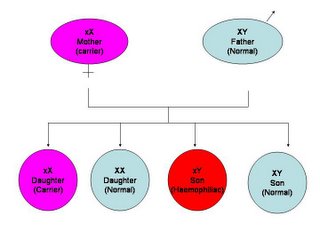
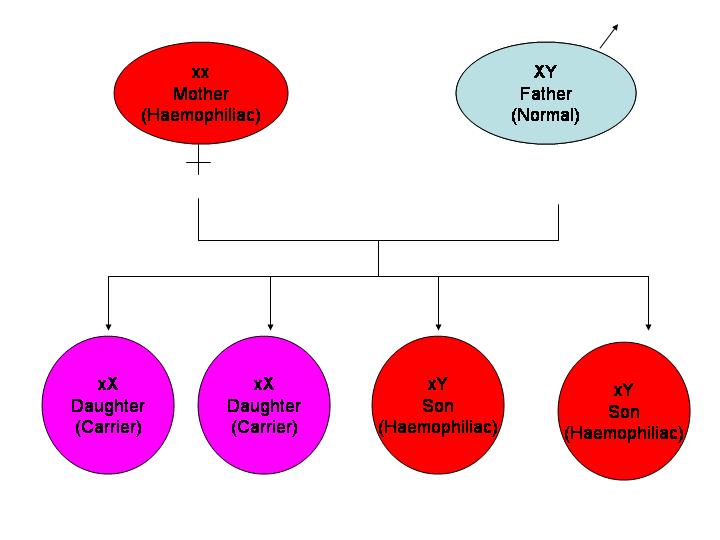
Haemophilia is inherited only through X chromosome. But in females, if the second X chromosome is normal, they become only carriers. A carrier is just like a normal woman who never suffers from haemophilia (because of the presence of a normal X chromosome), but her children who inherit the wrong x chromosome from her will be affected.
1. Children of a carrier mother and a normal father:
Daughters will be carriers with 50% probability
Sons will be haemophiliacs with 50% probability.
1. Children of a carrier mother and a normal father:
Daughters will be carriers with 50% probability
Sons will be haemophiliacs with 50% probability.
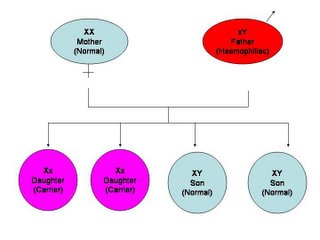
2. Children of a normal mother and a haemophiliac father:
All daughters will be carriers
All sons will be normal.
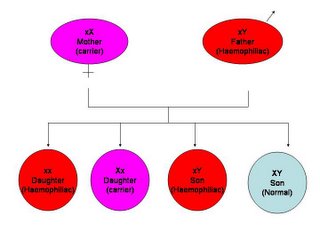
3. Children of a carrier mother and a haemophiliac father:
Daughters will be either carriers or haemophiliacs (No normal daughters)
Sons will be haemophiliacs with 50% probability.
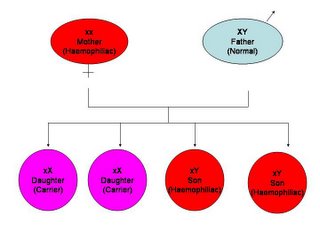
4. Children of a haemophiliac mother and a normal father:
All daughters will be carriers and all sons will be haemophiliacs.
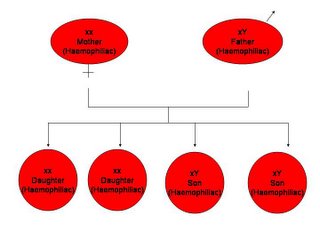
5. Children of a haemophiliac mother and a haemophiliac father:
All children will be haemophiliacs.
You must have read about Haemophilia in your 10th class Biology lessons. It is also known as The Royal Disease because it was first discovered in the royal family of England. Its incidence in the Russian Tsar (Czar)’s family has changed the course of world history during the World War I.
What is it at all? May be you were also dreaded that it is a very dangerous disease as there are several myths making rounds about it. Some of the widespread MYTHS are:
MYTH 1: It causes profuse bleeding. (Fact: bleeding is just normal)
MYTH 2: Even small cuts can be fatal. (Fact: Haemophilia affects the coagulation Factors which come into picture only when there is a major injury.)
MYTH 3: Haemophiliacs bleed to death. (Fact: here, at least three conditions are to be met:
1. The factor level is less than 1% which is an extremely rare case.
2. There should be a major injury where blood vessels are deeply cut.
3. No action is taken to stop the bleeding i.e., the injured may be unconscious and there is no one around to take care of him).
MYTH 4: There is no remedy. (Fact: There are no allopathic medicines yet but there are a number of remedies.
MYTH 5: It is caused by the deficiency of vitamin k. (Fact: Haemophilia is a genetic disorder)
There are some myths even among doctors. A friend of mine who is an MBBS doctor once opined that
(MYTH 6:) there can be haemophilic girls but no haemophilic women because they will bleed to death in their first menstruation! (Fact: See Myth 3 above.)
Fact: Depending on the factor levels, it takes longer for the bleeding to stop.
There are at least 15 factors and 5 proteins involved in the clotting process. All of them are numbered and some of them have common names as well, e.g.
Factor I: Fibrinogen,
Factor II: Pro-thrombin (this is usually inactive under the influence of anti-prothrombin called Heparin and becomes active when needed),
Factor III: Tissue Factor,
Factor IV: Calcium, etc. (Ca++ is essential in the coagulation process as a catalyst to spur factors like VII, IX, X XIII into action)
If Factor VIII is deficient, it is haemophilia Type A
If Factor IX is deficient, it is haemophilia Type B
In some cases, vWF may also be deficient or missing.
Factor levels:
• 25% to 150% of expected level is considered NORMAL.
• 5% to 25% is MILD haemophilia
• 1% to 5% is MODERATE
• less than 1% SEVERE.
Haemophilia is not a disease but a genetic disorder. It has two effects: 1. Prolonged bleeding and 2. swelling.
BLEEDING:
When the cut is minor, the blood vessel leading to the cut part contracts so that the amount of blood passing through it decreases and the wound heals without the need for any clotting process to take place.
When the cut is moderate, (a blood vessel is slightly cut), blood cells and fluid escape from the wound and the collagen fibres which are exposed initiate the clotting process.
Platelets rush to the spot to control the damage. Platelets release chemicals to attract more platelets. The accumulated and hardened platelets act like a plug to block the blood flow. This platelet plug is trapped in the mesh formed by the collagen fibres across the cut.
The clotting process starts with the thrombocytes releasing PF3.
PF3 + blood proteins -> Prothrombin
Prothrombin + Ca++ -> Thrombin
Thrombin + Fibrinozen -> Fibrin (in Gel state) which forms a net trapping corpuscles to form the clot
When the cut is major, Clotting or coagulation factors cause fibrin to stick together and seal the wound.
The adhesion of platelets to the collagen is mediated by von Willebrand factor (vWF). vWF also binds to and stabilizes coagulation factor VIII. Binding of factor VIII by vWF is required for normal survival of factor VIII in the circulation.
SWELLING:
Swelling is internal bleeding. The bleeding may be in joints or in muscles. Bleeding in muscles is not a serious one which may last for a couple of days and usually heals itself. The patient has to be careful about bleeding (i.e., swelling) in joints because if unattended to, it may persist for longer periods and the joint may get damaged permanently and the pain is also unbearable in severe cases. The extent of swelling also depends on the factor levels and the severity of the sprain or hit.
WHAT CAN AND SHOULD HAEMOPHILIACS DO?
• They must do normal exercises regularly. This will strengthen the muscles and helps in fast recovery. Yoga and aerobics are highly recommended.
• They can play all outdoor games but must avoid risky, adventurous games (like boxing).
• When there is any swelling or bleeding, bed rest is advised.
• In emergency cases, to increase the factor level considerably, they can opt for blood transfusion, plasma transfusion, or Factor VIII injections.
• Bleeding in the head, haematuria (blood in urine), bleeding in the stomach are dangerous especially when factor level is less than 1%. style="font-weight: bold;">Rush to the hospital immediately.
• Before undergoing any surgery, they must tell the doctor that they are haemophiliac.
. They should not donate their blood (if the factor-deficient blood is given to another bleeding haemophiliac, bleeding does not stop as expected and in critical cases, the patient may die).
WHO WILL INHERIT HAEMOPHILIA?
Haemophilia is inherited only through X chromosome. But in females, if the second X chromosome is normal, they become only carriers. A carrier is just like a normal woman who never suffers from haemophilia (because of the presence of a normal X chromosome), but her children who inherit the wrong x chromosome from her will be affected.
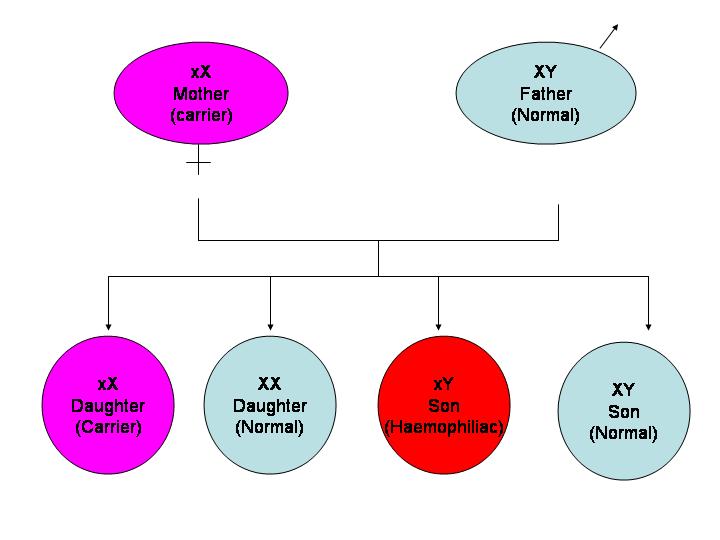
1. Children of a carrier mother and a normal father:
Daughters will be carriers with 50% probability
Sons will be haemophiliacs with 50% probability.
1. Children of a carrier mother and a normal father:
Daughters will be carriers with 50% probability
Sons will be haemophiliacs with 50% probability.
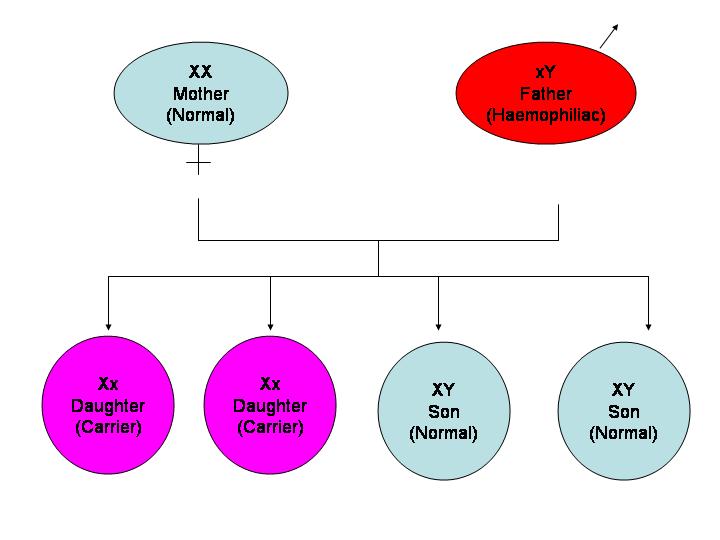
2. Children of a normal mother and a haemophiliac father:
All daughters will be carriers
All sons will be normal.
3. Children of a carrier mother and a haemophiliac father:
Daughters will be either carriers or haemophiliacs (No normal daughters)
Sons will be haemophiliacs with 50% probability.

4. Children of a haemophiliac mother and a normal father:
All daughters will be carriers and all sons will be haemophiliacs.
5. Children of a haemophiliac mother and a haemophiliac father:
All children will be haemophiliacs.

Jessica Lal
NDTV has launched a "Fight for Jessica Lal" campaign to garner support for a fresh trial in the ‘Jessica Lal murder case’ where all the nine prime accused were discharged by a Delhi sessions court last week.( Lal, a model, was filling in as a bartender in a posh south Delhi restaurant when she was shot in the wee hours of 30 April 1999. This happened after she reportedly refused to serve liquor to Manu Sharma, the son of Haryana Excise Minister Vinod Sharma. )
For details of this and similar cases in which justice was apparently denied, click here
For details of this and similar cases in which justice was apparently denied, click here
03 March, 2006
Bush visits India
Unnecessary
(A few "Letters to the editor" published on 3rd March, 2006)
That Mr. Bush is the head of the most powerful nation does not mean we have to extend a royal welcome to him. His hands are soiled with the blood of mankind, his head is cluttered with self-centred missions, and his heart is immune to the wails of humanity. The peace he trumpets cannot come from the policies he follows — fighting needless wars and killing the innocent.
Salil Gewali,
Shillong
In view of U.S. visas, job opportunities, and possible business ventures, our own people have let down Gandhi, who gave the greatest gift of non-violence to the world. They are welcoming one who is responsible for killing thousands around the world, running underground prisons, and treating fellow humans in the most inhumane way. I want to ask every Indian: Would the man who launched the non-cooperation movement against the British have shaken hands with Mr. Bush?
Pardeep Kansal,
Bathinda, Punjab
The Bush flu has already destroyed the Mesopotamian civilisation and set its sights on the Persian civilisation. It is hoped the Indian civilisation escapes.
R. Aravind,
Tirunelveli, T.N.
By now, Mr. Bush should be accustomed to protests in every state he visits. Anyone who misguides his citizens, and is remorseless about invading sovereign republics under a false pretext is a non-welcome entity in our land that epitomises non-violence as a way of life.
Yasmin Banu,
Abu Dhabi, UAE
Why are dollars welcome but not Mr. Bush? Because the dollars are part of the wages honestly earned. Young engineers toiling round the clock in MNCs are pampered with buffets in star hotels for their commendable work. Doctors burn the midnight oil to get through not only USMLE but many other competitive examinations. Winding queues outside the consulates are a reflection of the U.S.' scant regard for others, an attitude evident in the affluent bureaucracy of the American embassies.
True, Gandhi was kindly disposed towards his enemies (Letters, March 1). But that did not prevent us from punishing his assassins.
T. Ramadas,
Visakhapatnam, A.P.
The unprecedented security arrangements for Mr. Bush's visit are in total contrast to the 1947 padyatra of Gandhiji when communal riots broke out in Naokhali immediately after Independence. Gandhiji vehemently opposed any security for himself. It was because he had a clean conscience. Only a person who has something to fear requires elaborate security.
K.S.S. Sarma,
Kurnool, A.P.
It is all very well to invoke the athithi devo bhava concept (Letters, March 2). But let us also recall Vishnu's Vamana avtaar, in which he came as a guest of King Mahabali.
He was accorded the warmest of welcomes and asked to seek any gift of his choice. Vamana sought just three feet of land and that was the end of Mahabali.
S. Sathiyamoorthy,
Nagpur
17 February, 2006
The Clemenceau issue
The French aircraft carrier Clemenceau has on board 27,000 tonnes of steel, asbestos, PCBs, lead, mercury, and other toxic chemicals. Steel can be recycled and it is said to be the cheapest source. But the objection is about hazardous wastes like asbestos and others mentioned above.
(Nobody knows the exact amount of asbestos on the ship: French reports say it is around 40 to 50 tonnes while some other reports put it above 500 tonnes, still others say it is more than 700 tonnes.)
Clemenceau was off to India to be broken up by hand in Alang ship-breaking yard on the Gujarat coast where impoverished workers are injured and die every day of hazardous asbestos. The international standard for asbestos inhalation by men is less than 5 fibers/litre whereas the inhalation level in these units is more than 300 fibers/litre. No activist has ever raised his or her voice in this regard.
Egypt has serious doubts about the load Clemenceau carries and hence objected to allow passage to the ship thru Suez canal and now the ship has to return to France taking the long route around Africa. The French government is of the opinion that much of the toxic waste of the ship has been removed and hence it is not violating Basel Convention that bans trade on hazardous materials like asbestos.
But environmentalists and activists of "Greenpeace" and “Ban Asbestos Network” say that these are only excuses to dump hazardous wastes in poor countries like India which still do not have strong rules to prevent such dumping. Annually about 600-700 large sea-vessels are brought to Asian countries like India, Bangladesh, Pakistan, China and Turkey for breaking them into scrap affecting the workers and polluting the soil, sea and marine organisms of the area.
Let us face the fact: "Ship breaking units have disastrous consequences on marine ecosystem besides leading to many other social and economic problems". But another angle to the story is that the workers in the Ship breaking units want the ship to come albeit with toxic materials because it provides food to them however toxic it is. The pathetic working conditions, lack of any safety measures, utter disregard for the workers’ rights are terrible.
there are more than 700 large-scale and small-scale industries in India that use asbestos as the raw material; more than 5 lakh people are employed in such industries.
(The Directive Principles of State Policy in Part IV of our Constitution talk of providing ideal working conditions for all but the reality is nowhere near the ideal conditions described there.)
How serious is the risk?
Nearly 50 countries in the world have banned the use of asbestos. The adverse impact of asbestos use has been further established with major Japanese manufacturers having admitted scores of asbestos-related deaths amongst former employees, customers and local people.
The news about the death of 86 former employees of Nichias Corporation due to asbestos-related disease since 1976 (an avg of 3 deaths per year in a single organization over three decades) attracted media attention throughout Japan on July 5, 2005.
There are several other Japanese companies, which have recently disclosed asbestos deaths amongst their workforce. But the extent of the human tragedy due to asbestos exposure remains uncovered in India.
The Union Ministry of Health informed the Parliament in 2003 that studies by the National Institute of Occupational Health, Ahmedabad, have shown that exposure to any type of asbestos can lead to the development of asbestosis, lung cancer and mesothelioma.
White asbestos continues to be in use in India although other kinds such as blue and brown asbestos are banned. About one lakh (0.1 million) workers are directly exposed and 3 crore (30 million) construction workers are being subjected to asbestos dust on a day-to-day basis. Besides the workers, even common citizens are at risk.
Strange Case:
In Canada, there is a "no home use" policy for asbestos but Canada happily exports asbestos to India! In India, the total use of asbestos is 1.25 lakh tonnes, out of which more than 1.0 lakh tonne is being imported.
The ruling of the Supreme Court that the Clemenceau issue should not be discussed in the media raised several eyebrows. What is sub judice? Wait for a later post.
(Nobody knows the exact amount of asbestos on the ship: French reports say it is around 40 to 50 tonnes while some other reports put it above 500 tonnes, still others say it is more than 700 tonnes.)
Clemenceau was off to India to be broken up by hand in Alang ship-breaking yard on the Gujarat coast where impoverished workers are injured and die every day of hazardous asbestos. The international standard for asbestos inhalation by men is less than 5 fibers/litre whereas the inhalation level in these units is more than 300 fibers/litre. No activist has ever raised his or her voice in this regard.
Egypt has serious doubts about the load Clemenceau carries and hence objected to allow passage to the ship thru Suez canal and now the ship has to return to France taking the long route around Africa. The French government is of the opinion that much of the toxic waste of the ship has been removed and hence it is not violating Basel Convention that bans trade on hazardous materials like asbestos.
But environmentalists and activists of "Greenpeace" and “Ban Asbestos Network” say that these are only excuses to dump hazardous wastes in poor countries like India which still do not have strong rules to prevent such dumping. Annually about 600-700 large sea-vessels are brought to Asian countries like India, Bangladesh, Pakistan, China and Turkey for breaking them into scrap affecting the workers and polluting the soil, sea and marine organisms of the area.
Let us face the fact: "Ship breaking units have disastrous consequences on marine ecosystem besides leading to many other social and economic problems". But another angle to the story is that the workers in the Ship breaking units want the ship to come albeit with toxic materials because it provides food to them however toxic it is. The pathetic working conditions, lack of any safety measures, utter disregard for the workers’ rights are terrible.
there are more than 700 large-scale and small-scale industries in India that use asbestos as the raw material; more than 5 lakh people are employed in such industries.
(The Directive Principles of State Policy in Part IV of our Constitution talk of providing ideal working conditions for all but the reality is nowhere near the ideal conditions described there.)
How serious is the risk?
Nearly 50 countries in the world have banned the use of asbestos. The adverse impact of asbestos use has been further established with major Japanese manufacturers having admitted scores of asbestos-related deaths amongst former employees, customers and local people.
The news about the death of 86 former employees of Nichias Corporation due to asbestos-related disease since 1976 (an avg of 3 deaths per year in a single organization over three decades) attracted media attention throughout Japan on July 5, 2005.
There are several other Japanese companies, which have recently disclosed asbestos deaths amongst their workforce. But the extent of the human tragedy due to asbestos exposure remains uncovered in India.
The Union Ministry of Health informed the Parliament in 2003 that studies by the National Institute of Occupational Health, Ahmedabad, have shown that exposure to any type of asbestos can lead to the development of asbestosis, lung cancer and mesothelioma.
White asbestos continues to be in use in India although other kinds such as blue and brown asbestos are banned. About one lakh (0.1 million) workers are directly exposed and 3 crore (30 million) construction workers are being subjected to asbestos dust on a day-to-day basis. Besides the workers, even common citizens are at risk.
Strange Case:
In Canada, there is a "no home use" policy for asbestos but Canada happily exports asbestos to India! In India, the total use of asbestos is 1.25 lakh tonnes, out of which more than 1.0 lakh tonne is being imported.
The ruling of the Supreme Court that the Clemenceau issue should not be discussed in the media raised several eyebrows. What is sub judice? Wait for a later post.
15 February, 2006
Note:
This blog continues its mission ie, to create awareness among its readers about serious, socially relevant issues. I have started a couple of new blogs to air my views on different matters. I am moving some of the posts from here to avee-ivee.blogspot.com:
1. puraanaalu.blogspot.com throws new light on old stories. (Telugu blog - u need IE 6.0 or later versions to view)
2. avee-ivee.blogspot.com about miscellaneous topics (bilingual).
1. puraanaalu.blogspot.com throws new light on old stories. (Telugu blog - u need IE 6.0 or later versions to view)
2. avee-ivee.blogspot.com about miscellaneous topics (bilingual).
11 February, 2006
Good news and Bad news
The good news is that Telugu media is also publishing reports about the damage done by Cola plants. See the report: http://www.eenadu.net/story.asp?qry1=28&reccount=31
and the bad news is that some of our "stars" are still turning a Nelsonian eye to the common cause and now Sania Mirza has joined them. She is all set to promote the cool drink "Sprite" of Coca Cola group.
and the bad news is that some of our "stars" are still turning a Nelsonian eye to the common cause and now Sania Mirza has joined them. She is all set to promote the cool drink "Sprite" of Coca Cola group.
06 February, 2006
A habit that may hit Hyderabadis hard

DANGEROUS TREND: Yakking on mobile while driving.
K. Srinivas Reddy
HYDERABAD: Hyderabadis sure are unable to get over this syndrome - Driving WhileYakking (DWY).
Motorists in the twin cities seem to willingly give themselves up to this irresistible urge to yak while driving. But the law enforcers are not amused anymore. Police have begun cracking the whip after the Andhra Pradesh High Court specifically pointed out the growing tendency to flout the law against use of mobile phones while driving.
And instances of motorists arguing with policemen have been on the rise ever since police launched a drive against the DWY syndrome three months ago. As many as 13,000 motorists have been flagged down and handed over penalties of Rs 200 each. But that was during the period of leniency -- the drive was limited to certain traffic junctions only.
Personnel of the traffic police wing are now bracing themselves for a vigorous enforcement and also for some real hot arguments from the motorists. "It can be distracting and it's dangerous not only for the mobile user, but also other road users. We will certainly check this," asserts Additional Commissioner A.K. Khan.
Why would people chat on mobile phones while driving? The question defies any answer as everyone agrees that talking while driving is certainly distracting. "Yes. It's dangerous. Police are doing the right thing," concurred Y. Preetam, a businessman from Narayanguda.
Hands-free earphones
Intriguingly, he was answering the query from The Hindu on his mobile while driving.
Would the police crack down on use of hands-free earphones or those using the Bluetooth? Mr. Khan says the enforcement is against those taking or making calls while driving, whether they use hands-free sets or not. But considering the shortage of manpower to catch the motorists in the act, police could only crack down on those holding mobile phones to their ears.
"They should be pragmatic and encourage 'hands-free' conversations," says A. Srikanth, a dentist. "If distraction is the issue, what about DVD players in cars? Will it take few more years before the police wake up?" questions A. Kalyan Reddy from Padmaraonagar. A software analyst Sanjay Punjari argues: "I don't see any reason why hands-free mobile conversations should not be allowed. Otherwise, the police move to ban talking on cell phones is a right decision."
So what do you think? Write to us on downtownhyd@thehindu.co.in
(Published on 2nd Feb 2006)
yak or yack = to talk continuously about things that are not very serious or important
01 January, 2006
Concerns over Coke

By MELANIE WARNER
Published: December 31, 2005
The Michigan University, which has 50,000 students on three campuses, on Thursday became the 10th college to stop selling Coca-Cola products because of concerns arising from accusations about the company's treatment of workers in bottling plants in Colombia and environmental problems in India...
Labor activists have said that Coca-Cola, through its Latin American bottlers, has been complicit in the deaths of eight union leaders and in continued harassment of unionized employees.
In India, a different group of activists have accused Coke of polluting the soil and groundwater near several bottling plants, of severely reducing groundwater levels in drought-prone areas and of failing to install adequate filtration systems that would remove pesticides from the water used to make its products.(see my previous posts "The Plight of Plachimada" and "Chiranjeevi's Cola Ad" in 'Archives (October 2005)' and also visit:
http://www.cseindia.org/misc/cola-indepth/index.htm
-3vkrm)
The activists, led by two groups, Corporate Accountability International and the Campaign to Stop Killer Coke, have found a sympathetic ear on college campuses.
Within the last year, New York University, Rutgers University in New Jersey and Santa Clara University in California, among others, have stopped selling Coke products, which include Sprite, Dasani water, Minute Maid juice and Powerade sports drinks.
Coke has denied all of the accusations. In April, the company announced the findings of a report by CSCC, a consulting firm in Los Angeles. The report, which was paid for by Coke, addressed current conditions, not the deaths, which occurred from 1989 to 2002. It found no violations or abuses of labor or human rights in Coke's bottling plants in Colombia.
Unsatisfied, the University of Michigan and five universities that still sell Coke products have called for an independent investigation of both the Colombia and India situations.
The University of Michigan had set today as a deadline for Coke to select an auditor and agree on the terms of the investigation. But talks between the company and the university broke down.
Coke says the accusations about India are groundless, also. It says that its use of water in India has become more efficient and that it has begun harvesting rainwater to help return it to underground sources.
In the fiscal year 2005, the University of Michigan had 13 contracts for selling Coca-Cola products, totaling $1.4 million. The university did not have an exclusive contract with Coke and it will continue to sell beverages from other companies.
(A couple of sentences are omitted from the report)
24 December, 2005
Me in Teluguwiki
This post contains mainly what I wrote in Teluguwiki in Google groups over a couple of days. I feel it is a fruitful discussion we, a group of Telugu people have had there. In my next post I will try to present others' views as well.
If you find it interesting and want to raise a topic or participate in this kind of discussions, join as a member.
Now read on:
"Hundreds of words from English have already made their inroads into Telugu and successfully "masked" their equivalent Telugu words.
So what? - some may ask. A language reflects the culture, and the ethos of the people who speak that language. For example, consider this:
Respecting elders is an integral part of our culture. But in English language, there are no words to distinguish between elder and younger siblings! In South India, parallel cousins are as good as our own siblings but "jocular" as well as marital relations do exist between cross cousins. But in English there is no such distinction!
(Parallel cousins are children of our father's brothers or our mother's sisters and cross cousins are children of our father's sisters or our mother's brothers)
Still worse is the case when we can not distinguish between a man's elder sister-in-law and younger sister-in-law and between a woman's younger brother-in-law and elder brother-in-law.I can't count how many times I was confused when I hear someone talking about "rice" wondering whether it was 'biyyam' or 'annam'.
It happens only with Telugus. Tamilians' and Bengalis'love for their culture, language and food is well known.
But what I observed when I was in Delhi for some time is that:
In the heart of a cosmopolitan city like Delhi where people from not only every nook and corner of India but also from various parts of the world coexist,
1. A traffic signal is always called a "LAl batti (erra deepam)"
2. Crossroads are always called "gol chakkar".
3. A spoon is always called a "CHEMMACH"
4. Believe it or not, In post offices, I have heard with my own ears more than once an inland letter being called an"Antardeshiy Patr".
The question is about the importance being given to English and also about neglecting Telugu. Well, why should we learn English? The answer is very clear: to get better jobs.
But how should we learn English?This is the biggest question...
and the answer can not be by "Eating English, Drinking English, Speaking English, ..." ALL THE TIME sacrificing our own mother tongue.
It is a myth that English can be learnt only by studying in English medium schools and that too by moving away from Telugu language and Telugu culture. Even in a city like Hyderabad we can see hundreds or even thousands of people who have mastery over 4 or more languages.We have better known examples of PVNarasimha Rao and Puttaparthi Narayanacharyulu who learnt more than a dozen languages each. It is an established fact that Indians in general and south Indians in particular have the natural bility to comprehend different languages easily.
That being the case I fail to understand why people these days are trying to keep their chidren away from Telugu language and culture in their own land only to learn English and that too when it is more clear than ever that the present day children are smarter than their elders.
Here, one word of caution: Imparting primary education in a language other than the child's mother tongue renders the whole education meaningless. The child has to relate what is being taught in the class room with what is being faced in the outside world. This is possible only when the language used in the class room is the same as the language used at home and in the suroundings and the language the child is most comfortable in ie, its mother tongue. Otherwise, the child will get the feeling that the moment it enters the school, it is entering an entirely different world far removed from reality.This does not augur well either to the child or to the education system.
There are several people around us who don't know what an uTTi is. Such things will survive only in Bhagavatam stories.
English is a truly international language. It has its own regional flavours in various parts of the world. Still there is a long felt need to "Indianise" it more to better suit our cultural requirements. The process is going on (eg, we have introduced "co-brother" to English in addition to an embarrassingly ambiguous brother-in-law and have successfully converted 'enjoy' into an intransitive verb) but it needs to speed up.
English has many thousands of words which do not have equivalents in any other language leave alone Telugu and new words are being added to it every day. But one sensitive point we must note here is that every word is Anglicised before being added to it. But Telugisation is not done when importing words from English.
For example, "Bandicoot" is an English word taken from the Telugu word "Pandikokku". But not a single syllable in the English word has retained its original form. 'Pa' has become 'Ba'.'di' has become 'Di'. 'kokku' has become 'coot'. This is something like 'Suddhi'. Same is the fate of "kAsuneTTu" which has become 'cashewnut'. I am not suggesting to distort every English word we use as a revenge against English. But consider this:
Telugu is called the Italian of the east because in both the languages words end with small vowels (hAyi golipe hraswa achchulu-pondikaina poTTi achchulu). I have read somewhere that only these two languages have this property. This renders songs composed in these languages suitable for any tune (RAga) by conveniently stretching the last vowel or cutting it short. That is why the "prathamA vibhakti" Du,mu,vu,lu were imposed on almost every word imported into Telugu from Sanskrit by ppropriately appending one of the four letters at the end of the word. eg, RAmah has become RAmuDu, kAvyah has become kAvyamu, gOh has become govu, etc.
Just like every person has a personality of their own, every language has its own personality. But with the onslaught of English many languages are losing their identity.
Actually institutions like Telugu Academy, Telugu Viswavidyalaym, AdhikAra Bhasha Sangham should take up the task of retaining the originality and uniqueness of our language. But can we really hope that they wil do it?
Recently in a movie song, phrases like heerAdhiheeruDu, sTArAdhisTAruDu were coined.
Staradhistarudu sounds good but heeradhiheerudu is absurd and unacceptable.
Let me write briefly about the state of Telugu literature. Lately, there are new literary forms introduced into Telugu like Haikoos and nAnees. The streams of literature are steeming except drama. If one laments that in the past one hundred years there is no Telugu drama that stands anywhere near Kanyasulkam, we can't refute it. (If only Yandamuri continued writing dramas.......??)
But all other literary forms have greatly developed in style, and the topics they deal with are greatly diversified. Especially short story is said to be passing through its "Golden Age" now. Regarding novels, every year, at least a couple of good or great novels are coming out. We have Sannapureddy Venkatarami Reddy's "KADi", Chandra Latha's "RaegaDi Vittulu" etc on one side and novels like "Thapana" on the other. I don't follow poetry keenly and so I can't say anything about it. Regarding the Publishing houses, Prajasakthi
Book House has published a great number of books on children's literature. I suggest you regularly follow magazines like Rachana, Patrika, and more important: never ever think you are too old to read (Telugu) Chandamama.
In this discuusion when I said earlier "Actually institutions like Telugu Academy, Telugu Viswavidyalaym, AdhikAra Bhasha Sangham should take up the task .... But can we really hope that they wil do it?" I meant developing the language to meet the present day needs so that people using Telugu can have access to the latest developments in various disciplines.
If you find it interesting and want to raise a topic or participate in this kind of discussions, join as a member.
Now read on:
"Hundreds of words from English have already made their inroads into Telugu and successfully "masked" their equivalent Telugu words.
So what? - some may ask. A language reflects the culture, and the ethos of the people who speak that language. For example, consider this:
Respecting elders is an integral part of our culture. But in English language, there are no words to distinguish between elder and younger siblings! In South India, parallel cousins are as good as our own siblings but "jocular" as well as marital relations do exist between cross cousins. But in English there is no such distinction!
(Parallel cousins are children of our father's brothers or our mother's sisters and cross cousins are children of our father's sisters or our mother's brothers)
Still worse is the case when we can not distinguish between a man's elder sister-in-law and younger sister-in-law and between a woman's younger brother-in-law and elder brother-in-law.I can't count how many times I was confused when I hear someone talking about "rice" wondering whether it was 'biyyam' or 'annam'.
It happens only with Telugus. Tamilians' and Bengalis'love for their culture, language and food is well known.
But what I observed when I was in Delhi for some time is that:
In the heart of a cosmopolitan city like Delhi where people from not only every nook and corner of India but also from various parts of the world coexist,
1. A traffic signal is always called a "LAl batti (erra deepam)"
2. Crossroads are always called "gol chakkar".
3. A spoon is always called a "CHEMMACH"
4. Believe it or not, In post offices, I have heard with my own ears more than once an inland letter being called an"Antardeshiy Patr".
The question is about the importance being given to English and also about neglecting Telugu. Well, why should we learn English? The answer is very clear: to get better jobs.
But how should we learn English?This is the biggest question...
and the answer can not be by "Eating English, Drinking English, Speaking English, ..." ALL THE TIME sacrificing our own mother tongue.
It is a myth that English can be learnt only by studying in English medium schools and that too by moving away from Telugu language and Telugu culture. Even in a city like Hyderabad we can see hundreds or even thousands of people who have mastery over 4 or more languages.We have better known examples of PVNarasimha Rao and Puttaparthi Narayanacharyulu who learnt more than a dozen languages each. It is an established fact that Indians in general and south Indians in particular have the natural bility to comprehend different languages easily.
That being the case I fail to understand why people these days are trying to keep their chidren away from Telugu language and culture in their own land only to learn English and that too when it is more clear than ever that the present day children are smarter than their elders.
Here, one word of caution: Imparting primary education in a language other than the child's mother tongue renders the whole education meaningless. The child has to relate what is being taught in the class room with what is being faced in the outside world. This is possible only when the language used in the class room is the same as the language used at home and in the suroundings and the language the child is most comfortable in ie, its mother tongue. Otherwise, the child will get the feeling that the moment it enters the school, it is entering an entirely different world far removed from reality.This does not augur well either to the child or to the education system.
There are several people around us who don't know what an uTTi is. Such things will survive only in Bhagavatam stories.
English is a truly international language. It has its own regional flavours in various parts of the world. Still there is a long felt need to "Indianise" it more to better suit our cultural requirements. The process is going on (eg, we have introduced "co-brother" to English in addition to an embarrassingly ambiguous brother-in-law and have successfully converted 'enjoy' into an intransitive verb) but it needs to speed up.
English has many thousands of words which do not have equivalents in any other language leave alone Telugu and new words are being added to it every day. But one sensitive point we must note here is that every word is Anglicised before being added to it. But Telugisation is not done when importing words from English.
For example, "Bandicoot" is an English word taken from the Telugu word "Pandikokku". But not a single syllable in the English word has retained its original form. 'Pa' has become 'Ba'.'di' has become 'Di'. 'kokku' has become 'coot'. This is something like 'Suddhi'. Same is the fate of "kAsuneTTu" which has become 'cashewnut'. I am not suggesting to distort every English word we use as a revenge against English. But consider this:
Telugu is called the Italian of the east because in both the languages words end with small vowels (hAyi golipe hraswa achchulu-pondikaina poTTi achchulu). I have read somewhere that only these two languages have this property. This renders songs composed in these languages suitable for any tune (RAga) by conveniently stretching the last vowel or cutting it short. That is why the "prathamA vibhakti" Du,mu,vu,lu were imposed on almost every word imported into Telugu from Sanskrit by ppropriately appending one of the four letters at the end of the word. eg, RAmah has become RAmuDu, kAvyah has become kAvyamu, gOh has become govu, etc.
Just like every person has a personality of their own, every language has its own personality. But with the onslaught of English many languages are losing their identity.
Actually institutions like Telugu Academy, Telugu Viswavidyalaym, AdhikAra Bhasha Sangham should take up the task of retaining the originality and uniqueness of our language. But can we really hope that they wil do it?
Recently in a movie song, phrases like heerAdhiheeruDu, sTArAdhisTAruDu were coined.
Staradhistarudu sounds good but heeradhiheerudu is absurd and unacceptable.
Let me write briefly about the state of Telugu literature. Lately, there are new literary forms introduced into Telugu like Haikoos and nAnees. The streams of literature are steeming except drama. If one laments that in the past one hundred years there is no Telugu drama that stands anywhere near Kanyasulkam, we can't refute it. (If only Yandamuri continued writing dramas.......??)
But all other literary forms have greatly developed in style, and the topics they deal with are greatly diversified. Especially short story is said to be passing through its "Golden Age" now. Regarding novels, every year, at least a couple of good or great novels are coming out. We have Sannapureddy Venkatarami Reddy's "KADi", Chandra Latha's "RaegaDi Vittulu" etc on one side and novels like "Thapana" on the other. I don't follow poetry keenly and so I can't say anything about it. Regarding the Publishing houses, Prajasakthi
Book House has published a great number of books on children's literature. I suggest you regularly follow magazines like Rachana, Patrika, and more important: never ever think you are too old to read (Telugu) Chandamama.
In this discuusion when I said earlier "Actually institutions like Telugu Academy, Telugu Viswavidyalaym, AdhikAra Bhasha Sangham should take up the task .... But can we really hope that they wil do it?" I meant developing the language to meet the present day needs so that people using Telugu can have access to the latest developments in various disciplines.
23 December, 2005
08 November, 2005
CHIRANJEEVI WITHDRAWS

Chiranjeevi agrees to ask Cola firm to withdraw ad
Staff Reporter
VIJAYAWADA : Film actor Chiranjeevi has agreed to ask Coca Cola (India) to withdraw the `Thums Up truth challenge' advertisement in response to a request made by Jana Vignana Vedika (JVV).
Organisation's general secretary T.V. Rao, president V. Lakshmana Reddy and vice-president Jampa Krishna Kishore in a statement here on Tuesday said that the actor responded to a JVV representation which annexed signatures of 100 scientists.
The film star was requested to withdraw his `endorsement' to soft drinks that were causing several health problems to consumers.
The JVV leaders said that the actor faxed to the company his letter withdrawing endorsement to the advertisement.
A copy of the representation signed by scientists was faxed to Coca Cola (India) also, they said.
When contacted, Chiranjeevi's close relative and film producer Allu Aravind said the actor sent his letter to the company with regard to the advertisement.
Subscribe to:
Posts (Atom)